
Most unreadable chess scoresheets and failed PGN imports trace back to seven recurring notation mistakes: writing numeric zeros for castling (0-0), omitting piece disambiguation (Nd2 instead of Nbd2), dropping the departure file on pawn captures (d5 instead of exd5), transposing coordinate digits (c3 vs c4), handwriting stroke collisions between letters (K vs R), skipping a half-move so White and Black columns desynchronize, and misnumbering rows.
Under the FIDE Laws of Chess and the Portable Game Notation (PGN) specification, chess notation requires exact syntax. A single ambiguous or illegal token halts chess database imports and undermines claims during tournament play. Below is a breakdown of each mistake, the stroke and syntax traps that cause them, the correct fixes, and how automated validation catches them.
The 7 Most Common Chess Notation Mistakes
1. Writing Numeric Zeros (0-0) Instead of the Capital Letter O-O
On a scoresheet, writing numeric zeros for castling—0-0 (kingside) and 0-0-0 (queenside)—is correct per FIDE Appendix C.13. The O vs 0 issue only matters when the moves become PGN: it is the PGN standard (section 8.2.3, SAN) that requires the capital letter O (O-O, O-O-O), never the numeral zero.
- Incorrect in PGN:
0-0,0-0-0,o-o, oroo - Correct in PGN:
O-O(kingside),O-O-O(queenside)
The PGN syntax trap: While a scoresheet with 0-0 is correct per FIDE, strict PGN parsers flag 0-0 as an unknown token or an illegal move. Under the PGN standard (section 8.2.3, SAN), castling must use the capital letter O. The digit 0 is strictly reserved for move numbering or game result codes (1-0 and 0-1).
Handwriting Stroke Trap:
  Narrow / slashed zero:  [ 0 - 0 ]  --> Syntax error in PGN
  Round capital letter:   [ O - O ]  --> Valid SAN kingside castling
When transcribing moves into PGN or digital databases, write castling marks with the capital letter O so parsers process the moves cleanly.
2. Missing Move Disambiguation (Nd2 vs Nbd2)
When two identical pieces can legally move to the same square, a bare piece letter and destination coordinate are invalid. The move is ambiguous because a reader or database cannot tell which piece moved.
- Incorrect:
3. Nd2(when knights on b1 and f3 can both reach d2) - Correct:
3. Nbd2(the b1 knight) or3. Nfd2(the f3 knight)
Consider the opening moves 1. d4 Nf6 2. Nf3 e6. White has developed one knight to f3 while the other sits on b1. If White plays a knight to d2, both b1 and f3 have unobstructed access to d2. Writing 3. Nd2 produces an immediate error in database software.
Under FIDE Appendix C.10, disambiguation follows a strict three-tier hierarchy:
- Departure file first: If the pieces occupy different files, specify the departure file letter (e.g.,
Nbd2,Rae1). - Departure rank second: If both pieces share the same file, specify the departure rank number (e.g.,
R1e2vsR7e2). - File and rank together: Only if three or more promoted pieces share both file and rank perspectives does a move require full coordinates (e.g.,
Qa1e5).
For the full hierarchy and multi-piece edge cases, see our full guide to chess notation.
3. Dropping the Capture Marker x or Pawn Departure File (d5 vs exd5)
Omitting operational symbols creates silent errors. While some tolerant engines can deduce a missing x on piece captures (interpreting Bf7 as Bxf7), missing departure files on pawn captures break replay completely.
- Incorrect:
d5(when recording a pawn capture on d5) orBf7(when capturing with check) - Correct:
exd5(orcxd5), andBxf7+
In the Scandinavian Defense after 1. e4 d5, White captures Black's pawn. Recording 2. d5 tells the parser that White made a standard pawn push to d5. But White has no pawn capable of pushing forward to d5, and the square is already occupied by Black. The replay halts with an illegal move.
Always include the departure file for pawn captures (exd5), append + when the opposing king is placed in check (Qh5+), use # for checkmate (Qxf7#), and write en passant captures by their landing square (exd6, or optionally exd6 e.p.).
4. Transposing Similar Destination Coordinates (c3 vs c4, e4 vs e5)
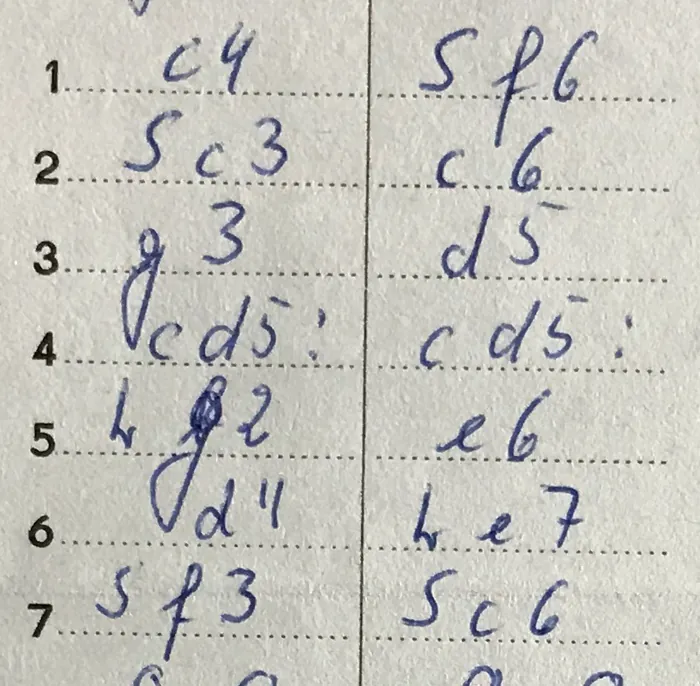
Under rapid play or time trouble, destination coordinates frequently suffer from penmanship slips that transpose ranks or files.
| Stroke Confusion | Handwriting Mechanism | Why It Corrupts Replay | Correction Rule |
|---|---|---|---|
c3 vs c4 | Flat horizontal top of 3 closes into the angular crossbar of 4 | Both are common opening squares (e.g., Nc3 vs Nc4, c3 vs c4). A misread transposes pawn structures. | Form 3 with two distinct curved lobes; lift the pen before the crossbar of 4. |
b vs 6 | Ascender of file letter b loops inward, mimicking the digit 6 | Produces syntactically invalid coordinates like 66 instead of b6. | Keep file letters strictly lowercase with an upright vertical stem. |
e4 vs e5 | Rounded top stroke on 5 resembles the loop of a handwritten 4 | Alters central pawn presence, causing downstream moves to become illegal. | Write 4 with sharp intersecting strokes and 5 with a flat top bar and rounded bowl. |
A single transposed coordinate desynchronizes the board state. If White writes 5. d4 when they actually played 5. d3, the error may look plausible for one move, but several moves later an engine will reject an impossible piece development based on that phantom pawn position.
5. Illegible Piece Letters and Stroke Collisions (K vs R, B vs 8)
Handwriting collisions between uppercase piece letters are among the most frequent causes of transcription failure:
- King (
K) vs. Rook (R): Writing a cursiveKwithout lifting the pen connects the vertical stem to the upper diagonal, producing a loop that reads asR. If a scoresheet recordsRe2instead ofKe2, a parser checking the board will search for a rook on the e-file or second rank. If the square is occupied or the king is under attack, the file fails validation. - Bishop (
B) vs. Digit8orP: A hurriedBwith rounded upper and lower bowls easily reads as8(turningBc4into8c4). Because digits cannot lead a SAN token, database parsers immediately crash. Furthermore, pawns carry no initial letter: writingPe4violates standard algebraic notation.
Stroke Anatomy Comparison:
  King [ K ]:    Vertical stem | followed by two distinct diagonal arms <
  Rook [ R ]:    Vertical stem | with closed upper bowl D and diagonal leg \
  Bishop [ B ]:  Closed upper and lower bowls; never substitute for a pawn
Print piece letters as crisp, disconnected uppercase capitals (K, Q, R, B, N). If you are working through an unfamiliar sheet, consult our guide on how to read a chess scoresheet to decipher difficult penmanship.
6. Skipping a Half-Move and Desynchronizing Score Columns
A tournament scoresheet organizes moves into numbered rows with dedicated columns: White on the left, Black on the right. If you fail to record a single half-move and enter White's next move into Black's column, every subsequent move on the scoresheet is offset by a half-turn.
- The error: White plays
12. Bb5, Black answers12... a6(unrecorded), and White writes13. Ba4in Black's move 12 box. - The consequence: Every move that follows attributes White's moves to Black and vice versa. Within one or two moves, the sequence attempts illegal moves (pawns moving backward or pieces leaping through opposing pawns).
If you lose track during play, leave the uncertain cell empty rather than shifting moves into the opposite column. Our guide on how to fill out a chess scoresheet details column discipline during rapid games.
7. Misnumbering Move Rows and Mid-Game Recovery Rules
Misnumbering occurs when a player duplicates a move number (12. Bb5 a6, followed by 12. Ba4 Nf6) or skips a number (24, followed by 26). On unnumbered scorebooks or blank paper, this immediately misleads anyone replaying the game.
During a tournament game governed by FIDE or USCF rules, recovering from a missed move or row offset requires strict adherence to tournament regulations:
- Do not inspect your opponent's sheet during active play: Article 11.5 of the FIDE Laws of Chess forbids distracting or annoying the opponent in any manner. You may not lean across the board to copy their moves while their clock is running.
- Catch up on your own clock: If you notice your notation has desynchronized or fallen behind, you must make corrections on your own time (while your own clock is running), or wait until the time control is reached.
- Requesting the opponent's sheet: Under FIDE Article 8.5.2, if only one player has not kept score under Article 8.4, he/she must, as soon as either flag has fallen, update the scoresheet completely before moving a piece; provided it is that player's move, he/she may use the opponent's scoresheet but must return it before making a move. Under Article 8.5.3, if no complete scoresheet is available, the players reconstruct the game on a second board under the control of the arbiter or an assistant.
- Single strike-through rule: When correcting an error on paper, draw a single neat horizontal line through the incorrect token (
~~Nc3~~ Nbd2). Never scribble over numbers or black out cells, as arbiters must be able to inspect earlier entries during disputes.
For the exact tournament obligations governing recording and time scrambles, review the FIDE scoresheet rules. If you are transcribing vintage scorebooks recorded in older systems, consult our guide on descriptive vs. algebraic notation.
How Software and Scanners Catch Notation Errors Automatically
Manual transcription requires proofreading 80 or more half-moves per game. Modern verification tools and optical scanners automate this by combining character recognition with full board-state validation:
Scoresheet Image
       │
       ▼
 [OCR Token Extraction] ───► e.g., "Nd2" detected
       │
       ▼
 [Board-State Validation (FEN)]
       │
       ├─► Legal & Unambiguous? ───► Token Accepted (e.g., "e4")
       ├─► Structurally Illegal? ──► Flagged in RED (e.g., "Bxf7" on empty square)
       └─► Ambiguous Candidate? ──► Flagged in AMBER (e.g., "Nd2" -> offers Nbd2 / Nfd2)
- Board-State Replay (FEN Tracking): Rather than treating notation as plain text, chess engines replay the move sequence from the standard starting position (or a custom FEN).
- Flagging Illegal Moves (Red): If a handwritten token translates to an impossible move—such as moving into check, pushing an obstructed pawn, or jumping a bishop over a piece—the validator highlights the move in red.
- Resolving Ambiguity (Amber): When a token lacks disambiguation (such as
Nd2when knights on b1 and f3 can both move there), or when handwriting confidence betweenKandRis split, the system flags the move in amber and provides legal candidate moves based on the current position. - Pre-Export Validation: You can test any suspicious text sequence in our free PGN validator before importing it into your chess database.
Digitizing Scoresheets with ScanChess
When you upload a scoresheet photo to ScanChess, you do not need to manually trace where handwriting drifted or where a column desynchronized.
ScanChess processes the scoresheet image, extracts the moves, and steps through the game on an interactive board:
- The desktop interface displays the original scoresheet photo side-by-side with the digital move list and board.
- Illegal moves are highlighted in red, while ambiguous moves or low-confidence strokes appear in amber alongside rule-legal alternatives.
- You can correct flagged moves with a single click, verify the game via the interactive replay board, and export a clean, tournament-ready PGN file.
To maintain clean habits at the board and avoid crowded cells, you can also download formatted printable scoresheets designed with optimal spacing for tournament play.