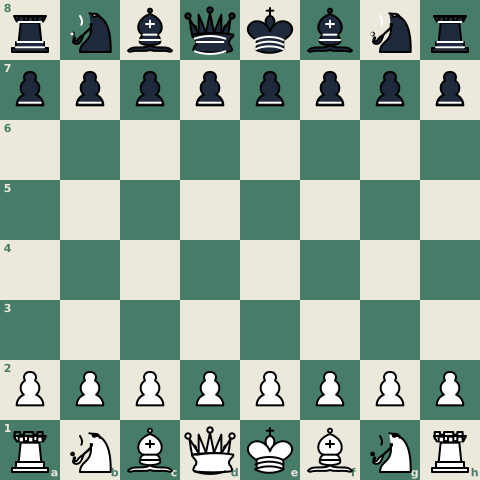

To fill out a chess scoresheet, complete the header before the round begins, record each full turn row by row (White in the left move column, Black in the right), and enter the final result and signatures once the game finishes. Under tournament rules, you must make your move on the board and press the clock before writing it down in Standard Algebraic Notation (SAN). Note draw offers with the symbol (=), draw a single clean line through any mistake, and keep characters centered inside the grid boxes. If you are learning the reverse skill of decoding an unfamiliar or historical scoresheet, see our companion guide on how to read a chess scoresheet.
Example: Two Filled-In Scoresheets
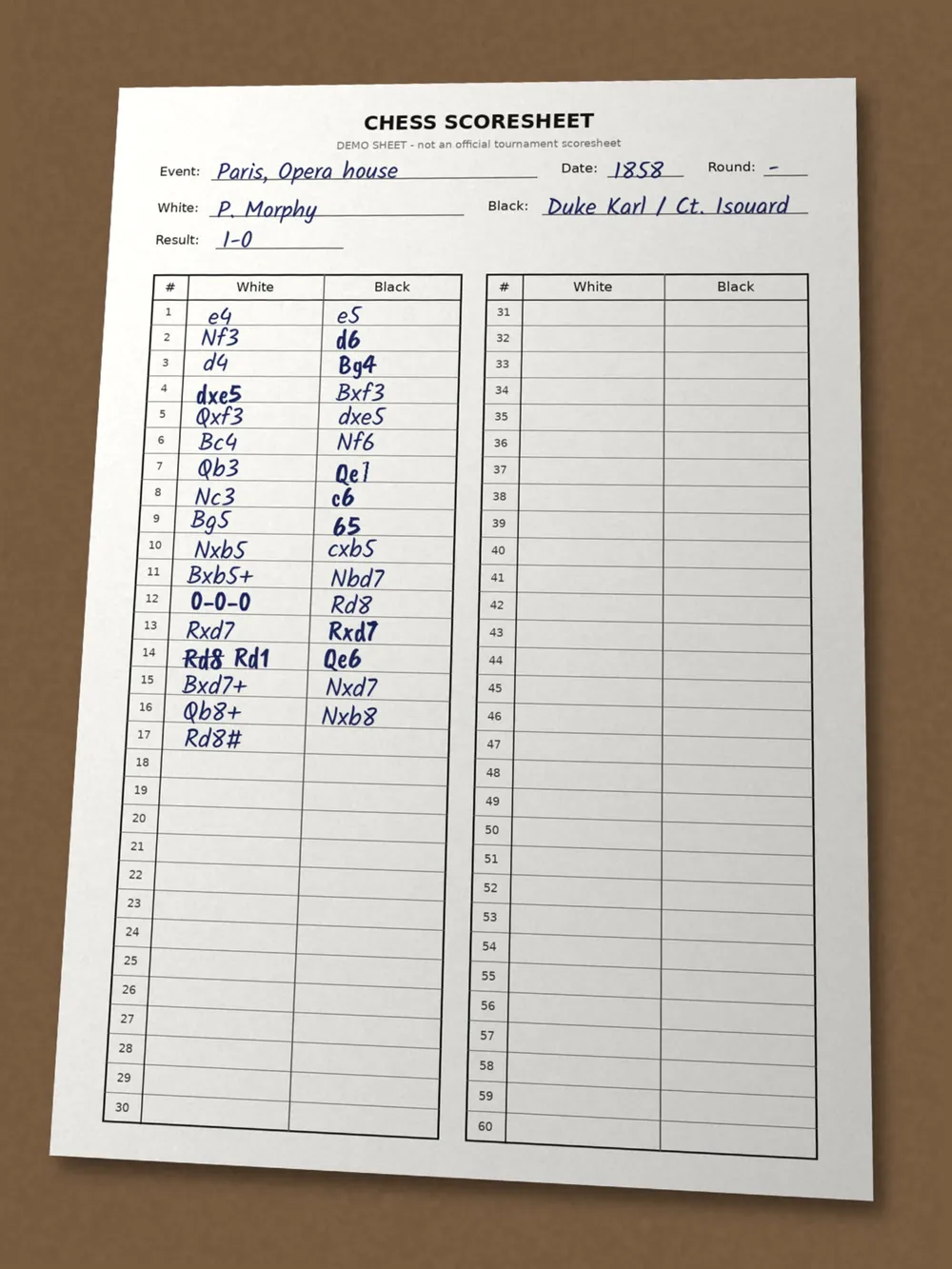
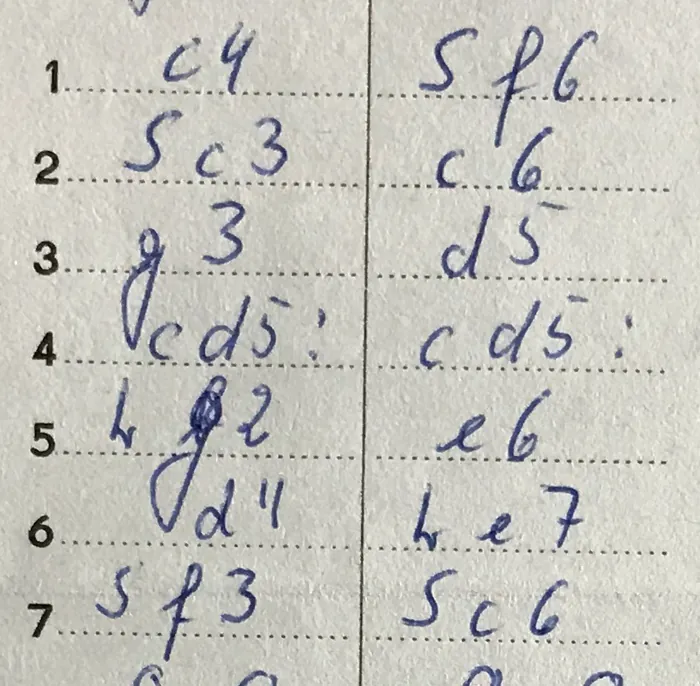
Below are two filled-in sheets: a demo scoresheet of the 1858 Opera Game (Paul Morphy vs Duke Karl of Brunswick and Count Isouard) that we filled in ourselves, and a real 1973 tournament scoresheet from the Berliner Silvesterturnier (Juliane Hund vs Finkenzeller).
Notation Breakdown of the Opera Game
Every cell on the scoresheet corresponds to a legal board move and follows standard recording rules:
| Move # | White | Black | Notation Rule Illustrated |
|---|---|---|---|
| 1 | e4 | e5 | King's pawn openings. Pawns carry no piece letter; only the destination square is written. |
| 2 | Nf3 | d6 | Minor piece development. Knights use N because K is reserved for the King. |
| 3 | d4 | Bg4 | A pawn move and a bishop move: only bishops, knights, rooks, queens and kings get a letter. |
| 4 | dxe5 | Bxf3 | Pawn capture (dxe5 includes departure file d) and minor piece capture (Bxf3). |
| 5 | Qxf3 | dxe5 | Queen recapture and central pawn recapture. |
| 6 | Bc4 | Nf6 | Ordinary piece moves: letter plus destination square. |
| 7 | Qb3 | Qe7 | On our demo sheet the 7 of Qe7 is written with almost no top bar and reads as Qe1. Close the top of a 7 so it cannot pass for a 1. |
| 8 | Nc3 | c6 | Knight development and central pawn support. |
| 9 | Bg5 | b5 | On our demo sheet the short-stemmed b reads as 65. Give b a tall stem. |
| 10 | Nxb5 | cxb5 | Two captures: a piece capture (Nxb5) and a pawn capture, which names the file the pawn left (c). |
| 11 | Bxb5+ | Nbd7 | Check and Disambiguation: White's Bxb5+ gives check (+). Both black knights (b8 and f6) can reach d7, so Black must write the departure file: Nbd7. |
| 12 | 0-0-0 | Rd8 | Queenside castling: on paper scoresheets, FIDE notation (Appendix C.13.2) writes castling with numeric zeros (0-0-0). PGN files use O-O-O. |
| 13 | Rxd7 | Rxd7 | White's rook takes the knight on d7 and Black's rook recaptures. |
| 14 | Rd1 | Qe6 | Struck-through correction: White originally wrote Rd8, struck it through with a single clean line, and wrote Rd1 beside it. |
| 15 | Bxd7+ | Nxd7 | Bishop capture with check (+) and knight recapture. |
| 16 | Qb8+ | Nxb8 | Queen move with check, then a knight capture. |
| 17 | Rd8# | (none) | Checkmate: White's rook delivers mate on d8, denoted by #. Final result is recorded as 1-0. |
Step 1: Fill In the Header First
Complete the header before the round starts, while your clock is not running. Arbiters rely on header metadata to link physical scoresheets to tournament pairing rosters and resolve board disputes. Most sheets ask for:
- Event: Name of the tournament or club match.
- Date & Round: The calendar day and specific round number.
- Board Number: Your assigned board, matching the official pairing sheet.
- Player Names: Your full name and your opponent's name, placed on the corresponding White and Black lines.
- Ratings & Section: Helpful for rating report verification and pairing tiebreaks.
Filling the header in advance prevents scrambling after a tense game. If your club or event provides paper stationery, using standardized printable scoresheets ensures high-contrast grids and clean margins for writing; choosing a chess score sheet compares the 60-move, 80-move and junior layouts.
Step 2: Record Each Move in the Right Column
A scoresheet organizes the game into numbered rows called move pairs: White's turn in the left column, Black's reply in the right column.
The Move-First Rule (FIDE Article 8.1.2)
Under Article 8.1.2 of the FIDE Laws of Chess, recording moves in advance is strictly forbidden (except when claiming a draw under Article 9.2 for threefold repetition or Article 9.3 for the 50-move rule, or during sealed moves). Article 8.1.3 clarifies that a player may reply to an opponent's move before recording it, but must record their previous move before making another. In tournament play:
- Execute your move on the chess board.
- Press your clock with the same hand that moved the piece.
- Record the move on your scoresheet.
Writing a move before playing it is prohibited and can result in arbiter warnings or time penalties added to your opponent's clock.
In US Chess events, rule 15A also requires moving before writing by default, though some local directors allow writing first if the "paper scoresheet variation" (Variation I) is specifically announced. For details on domestic variations, see USCF scoresheet rules.
Standard Algebraic Notation (SAN)
Always record moves using Standard Algebraic Notation (SAN):
- Piece letters: Uppercase
K(King),Q(Queen),R(Rook),B(Bishop), andN(Knight). Pawns carry no initial letter (e4, notPe4). Under FIDE Appendix C.3, players are permitted to use national piece letters customary in their country on paper scoresheets (such asSfor Springer/knight,Lfor Läufer/bishop,Tfor Turm/rook, andDfor Dame/queen in German, as shown on the 1973 German scoresheet above). In digital PGN files, standard English piece letters are required. - Captures (
xor:): Under FIDE Appendix C.9, inserting anxfor captures is optional. On pawn captures, include the departure file (dxe5). On older German sheets such as the 1973 one above, a capture is marked with a colon after the move (Tc6:=Rxc6). - Castling: On paper scoresheets, FIDE's official notation (Appendix C.13.1 and C.13.2) writes castling with numeric zeros:
0-0for kingside (short) castling and0-0-0for queenside (long) castling. Digital PGN files use uppercase lettersO-OandO-O-O. - Check and mate: Append
+for check and#for checkmate. - Disambiguation: If two identical pieces can move to the same square, specify the departure file (e.g.,
Nbd7,Rae1) or departure rank (R1e2) under FIDE Appendix C.10.
If you are unfamiliar with coordinate names or rank-and-file syntax, our guide on chess notation explained covers the coordinate system from scratch.
How to Record a Draw Offer
Under FIDE Appendix C.13, an offer of a draw must be recorded on the scoresheet with the symbol (=). The correct tournament etiquette is:
- Make your move on the board.
- State clearly to your opponent: "I offer a draw."
- Press your clock.
- Write
(=)beside the move on your scoresheet.
Your opponent writes (=) on their sheet as well. Having this symbol recorded in ink gives the arbiter immediate proof of when an offer was tendered if a disagreement arises later.
Step 3: Record the Result
When the game ends by checkmate, resignation, draw agreement, or time forfeit, write the official result in the footer boxes:
1-0: White win.0-1: Black win.½-½(or1/2-1/2): Draw.
Confirm that the result you write matches your opponent's scoresheet and what will be posted on the pairing sheet.
Step 4: Sign the Scoresheet
After the result is written, both players must sign both scoresheets under FIDE Article 8.7.
Signing certifies that both players agree on the final outcome and move score. Once signed, the result is official and cannot be reversed based on informal board claims. Under tournament rules, scoresheets are the property of the event organizer; in most events, the original white copy is submitted to the arbiter desk while players retain duplicate carbon copies or photograph the sheet.
The Under-5-Minutes Rule (Time Trouble Exception)
Under FIDE Article 8.4, if a player has fewer than five minutes remaining on their clock and the time control does not provide an increment of 30 seconds or more per move, that player is exempt from recording moves.
Key requirements governing this exception:
- Temporary exemption only: You may stop writing during the time scramble, but as soon as the time control is reached (e.g., move 40), you must immediately bring your scoresheet up to date before making another move.
- No mid-game borrowing: You may not borrow or look at your opponent's scoresheet while your clock is running to fill in missing moves.
- Arbiter-supervised reconstruction: If both players have stopped writing, the arbiter reconstructs the missing moves on a separate demonstration board after the time control, using players' recollections, before regular play resumes.
For the exact wording and arbiter procedures governing clock time scrambles, see our full review of FIDE scoresheet rules.
Common Scorekeeping Scenarios
| Situation | Correct Board Action | Scoresheet Procedure |
|---|---|---|
| Handwriting error or slip | Keep the clock running | Draw a single neat line through the mistaken move (~~Nf3~~) and write the correct move clearly above it. Never scribble or ink out the cell. |
| Draw offer tendered | Move and press clock | Write (=) directly beside the move ply on both sheets. |
| Clock drops below 5 minutes | Focus on the clock and board | Stop writing if the increment is under 30 seconds. Reconstruct moves immediately once the time control is reached. |
| Reached bottom of Column 1 | Continue normal turn | Wrap to the top of Column 2 (move 31); never write horizontally across into adjacent columns. |
| Two identical pieces can move to square | Complete move on board | Write the departure file (Nbxd2) or departure rank (R1e2) to prevent an ambiguous move penalty. |
Writing Habits for Dispute Proofing and OCR Digitization
Whether an arbiter is verifying a threefold repetition claim or computer vision software is reading your sheet, clean handwriting prevents errors:
- Keep notation off the grid lines: Optical character recognition (OCR) models isolate characters by finding printed cell boundaries. When strokes or letters touch or cross grid borders, the bounding box can merge ink with the line, causing missed or misclassified moves.
- Use single-line strike-throughs: Never scribble dense, dark blobs or cross-hatching over mistakes. Dense ink blobs confuse vision models into detecting phantom characters and prevent arbiters from seeing what was previously written. Strike through cleanly and write the replacement above the line.
- Print uppercase block capitals: Avoid cursive ligatures that connect letters (such as
Nflowing intoforBflowing intoc). PrintK,Q,R,B, andNas distinct, upright capitals. - Castling on paper vs. PGN files: FIDE's official notation rules (Appendix C.13) write castling on paper scoresheets with numeric zeros (
0-0and0-0-0). Digital PGN files, however, use capital letters (O-OandO-O-O). In our 2026-09-30 test, Lichess, Chess.com and the ScanChess PGN validator all accepted0-0-0in a pasted PGN. For more stroke traps, see common chess notation mistakes. - Use a dark pen with firm pressure: Blue or black ballpoint pens produce crisp, consistent lines that will not smudge during play or fade on carbon duplicates.
After the Game: Digitizing Your Paper Record
A signed scoresheet preserves your game on paper, but analyzing games with engines, sharing them with coaches, or archiving them in a database requires a digital PGN file.
Instead of manually typing move pairs into a GUI, you can photograph your paper sheet and upload it to the ScanChess scanner. ScanChess pairs AI vision with a chess rule engine to replay the game move by move:
- Every ply is checked against legal board geometry.
- Illegal moves appear in red.
- Ambiguous or low-confidence characters appear in amber alongside candidate legal alternatives that can be accepted with an inline pencil click.
Once verified on an interactive board, the complete game exports as a standard PGN ready for your chess database. To learn more about transcribing and archiving physical sheets, explore our guide on how to convert handwritten scoresheet to PGN.