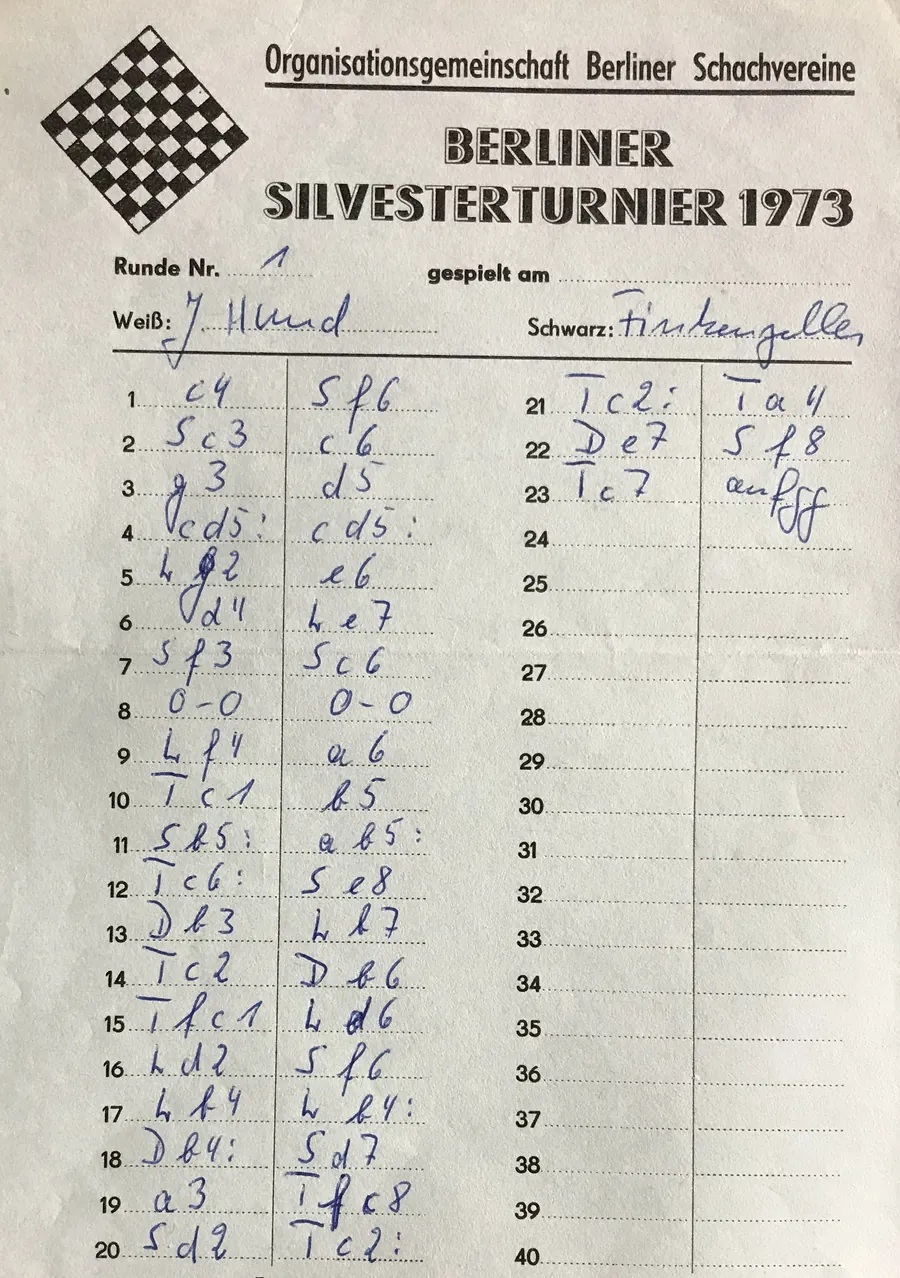

To read a chess scoresheet, look at it as a structured grid of numbered rows called move pairs. Each row records one full turn: the move number on the left, White's move in the middle column, and Black's reply in the right column. You read each row left to right (1. e4 e5), proceed down the column until move 30 or 35, and then wrap to the top of the next column or the back of the sheet. At the bottom, the final result is recorded as 1-0 (White win), 0-1 (Black win), or ½-½ (draw).
Below is how physical scoresheets are structured, how to navigate multi-column layouts, how to decipher messy handwriting, and how to read special in-game marks or older notation.
Anatomy of a Scoresheet
Tournament scoresheets (whether single-ply paper, carbonless NCR duplicates, or spiral scorebooks) follow a standardized three-part layout: header metadata, move columns, and the result footer.
+--------------------------------------------------------------+
| EVENT: Spring Open 2026   ROUND: 3   BOARD: 14   DATE: ...   |
| WHITE: Smith, J. (1820)             BLACK: Davis, A. (1795)  |
+--------------------------------------------------------------+
|     COLUMN 1 (Moves 1-30)     |     COLUMN 2 (Moves 31-60)   |
| No.  White    Black    [Time] | No.  White    Black    [Time]|
| 1.   e4       e5              | 31.  Rxe5     fxe5           |
| 2.   Nf3      Nc6             | 32.  Qd3      Kf7            |
| ...                           | ...                          |
| 30.  Rd1      Qe7             | 60.  ...      ...            |
+--------------------------------------------------------------+
| RESULT: 1-0 [ ]  0-1 [ ]  1/2-1/2 [X]                        |
| SIGNATURE (White): J. Smith    SIGNATURE (Black): A. Davis   |
+--------------------------------------------------------------+
A scoresheet is the official record of the game under FIDE scoresheet rules. Both players record each move, creating the paper evidence required to verify threefold repetition claims, confirm the 50-move rule, and document time controls.
Reading Order Across Columns
Reading a scoresheet correctly requires following the flow of the game rather than reading straight across the physical page:
- Read Move 1 from left to right: Identify the move number, White's move, and Black's reply.
- Follow Column 1 vertically down: Continue through moves 2, 3, 4, and downward to the bottom of the first block (typically move 30 or 35).
- Wrap to the top of Column 2: Do not read horizontally into the adjacent column. Move 31 begins at the top of the next column block (or on the back side of single-column sheets).
- Identify time columns: Many tournament sheets include a narrower column alongside the moves labeled "Time" or "Clock". This records elapsed time or remaining clock minutes (e.g.,
1:24), not a board move.
If you are filling out your own sheet at an event, see how to fill out a chess scoresheet for writing habits that prevent recording mistakes.
Move Notation Shorthand (SAN)
Scoresheets use Standard Algebraic Notation (SAN). For a complete primer on files, ranks, and coordinates, see chess notation explained. The core shorthand includes:
- Piece letters:
K(King),Q(Queen),R(Rook),B(Bishop), andN(Knight, since K is reserved for King). Pawns have no letter—only the destination square is recorded (e.g.,e4). - Captures (
x): Placed between the piece letter and target square (Bxf7). For pawn captures, the departure file is written first (exd5). - Special actions:
O-O: Kingside castling (short).O-O-O: Queenside castling (long).=: Pawn promotion, followed by the new piece (e8=Q).+: Check (Qh5+).#: Checkmate (Qxf7#).e.p.: Optional marker for en passant captures (exd6 e.p.).
- Disambiguation: When two identical pieces can move to the same square, the starting file or rank is inserted (e.g.,
Rad1orN1d2).
Worked Example: The Italian Game
If a sheet opens with moves you do not recognize, the chess opening identifier names the opening and its ECO code from the moves alone. Here is how the opening four move pairs of an Italian Game appear on a scoresheet:
| Move # | White | Black | Description |
|---|---|---|---|
| 1 | e4 | e5 | White advances king pawn to e4; Black mirrors to e5. |
| 2 | Nf3 | Nc6 | White develops knight attacking e5; Black develops knight defending e5. |
| 3 | Bc4 | Bc5 | White places bishop on c4; Black mirrors bishop to c5. |
| 4 | c3 | Nf6 | White prepares central pawn push; Black develops knight to f6. |
Deciphering Messy Handwriting and Faint Carbon Copies
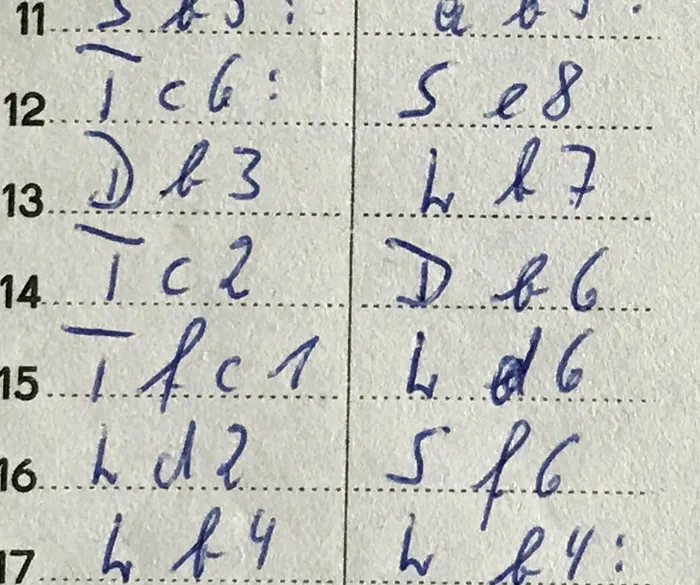
Deciphering physical scoresheets—especially the yellow or pink carbonless (NCR) duplicate sheets handed to opponents or arbiters—is often hindered by rushed penmanship or faint carbon transfer. Use these rules to decode ambiguous characters:
| Written Mark | Common Misreading | How to Disambiguate |
|---|---|---|
b (file letter) | Digit 6 | Check syntax position: a file letter always precedes a rank number. b6 is valid; 6b is not. |
B (Bishop) | Digit 8 or 13 | Piece letters appear at the start of a move. A character followed by a lowercase letter (Bc4) is a Bishop, not an 8. |
N (Knight) | M, v, or Z | Look at the destination square. If the character precedes f3 or c6, it is almost certainly a Knight. |
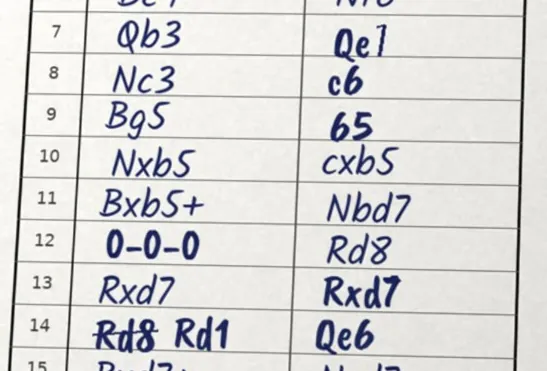
O-O (Castling) | 0-0 or o-o | Players under time pressure often write zeros or lowercase letters. Any 0-0 entry represents castling. |
+ (Check) | t, 4, or x | Check marks sit at the end of the move string (Qh5+), whereas capture x sits between piece and coordinate. |
| Faint Carbon Ply | Smudged or blank cells | Hold the duplicate sheet up to angled light to read pen indentations pressed into the paper fibers, or compare against the white original copy. |
Non-Standard Marks and In-Game Annotations
Tournament players frequently write supplementary symbols on scoresheets:
| Symbol / Mark | Name | Meaning on Scoresheet |
|---|---|---|
(=) or circle | Draw offer | The player offered a draw on this move (recorded by either player). |
1:42 or 45 | Clock notation | Time remaining on the chess clock, or minutes spent on that turn. |
Kt | Knight | Older English notation for Knight (used before N became standard). |
ch | Check | Written out instead of the modern + symbol. |
dbl ch / ++ | Double check / Mate | In older scoresheets, ++ signified double check or checkmate rather than #. |
: | Capture | Common in continental European scorebooks in place of x (e.g., B:f7). |
Reading Older Scoresheets: Descriptive Notation
If you are reading an older tournament archive or club scorebook recorded prior to the 1980s, the moves are likely written in Descriptive Notation rather than algebraic.
Descriptive notation names squares relative to each player's side based on the starting piece on each file:
- Piece symbols: Pawns are explicitly written as
P, knights asKtorN. - Files: Named for starting pieces:
QR,QN,QB,Q,K,KB,KN,KR. - Ranks: Counted 1 to 8 from each player's own back rank.
| Descriptive Notation | Modern Algebraic (SAN) | Notes |
|---|---|---|
1. P-K4 P-K4 | 1. e4 e5 | White's K4 is e4; Black's K4 is e5. |
2. N-KB3 N-QB3 | 2. Nf3 Nc6 | Knight to King Bishop 3; Black Knight to Queen Bishop 3. |
3. B-B4 B-B4 | 3. Bc4 Bc5 | White Bishop to Bishop 4 (Bc4); Black Bishop to Bishop 4 (Bc5). |
4. PxP | 4. exd4 (or similar) | Pawn captures Pawn. |
For a complete side-by-side mapping between both systems, see our guide on descriptive vs. algebraic notation.
The Footer: Result and Signatures
At the conclusion of the game, the final result is entered in the boxes at the bottom:
1-0: White won.0-1: Black won.½-½(or1/2-1/2): The game ended in a draw.
Both players sign the sheet to certify that the recorded result and move count are agreed upon. Once signed and submitted to the arbiter, the result is official.