
Under Article 8 of the FIDE Laws of Chess ("The recording of the moves"), players in classical rated tournaments are legally required to record both their own and their opponent's moves on the designated scoresheet. Far from being passive paperwork, the scoresheet is the official evidentiary log that arbiters rely on to rule on threefold repetition, confirm 50-move claims, inspect flag falls, and correct illegal moves. This article covers what the rules require; for the practical side of writing each move, see how to fill out a chess scoresheet.
| Rule Aspect | FIDE Requirement | Article Reference |
|---|---|---|
| Recording sequence | Move on the board first, then record on paper | Article 8.1.1 & 8.1.2 |
| Advance recording | Strictly forbidden (except when claiming a draw under 9.2 or 9.3) | Article 8.1.2 |
| Sheet visibility | Must remain visible to the arbiter and opponent throughout play | Article 8.2 |
| Time trouble waiver | Permitted only when clock is under 5 min AND increment is <30 sec | Article 8.4 |
| Catching up moves | Must use player's own clock time; never borrow sheet on opponent's turn | Article 8.5.2 |
| Rapid & Blitz formats | Recording is exempt by default in Rapid and entirely exempt in Blitz | Appendices A & B |
| Sheet ownership | Official property of the tournament organizer | Article 8.3 |
| Result ratification | Both players must sign both scoresheets; signed outcome stands | Article 8.7 |
The Obligation to Record Moves (Article 8.1)
Under Article 8.1.1, each player must record both sides' moves, move by move, in standard algebraic notation on the scoresheet prescribed for the event. If you need a refresher on standard notation syntax, see chess notation explained; to understand the grid layout and move boxes, see how to read a chess scoresheet.
Three operational rules govern move recording:
- Move first, write second: Article 8.1.2 forbids recording moves in advance; you must execute your move on the board before writing it down. The only exceptions occur when claiming a draw under Article 9.2 (threefold repetition) or Article 9.3 (50-move rule), or when adjourning: you write the claiming move on your scoresheet, leave the piece untouched on the board, stop the clock, and summon the arbiter.
- Sequential recording: Under Article 8.1.3, you may reply to an opponent's move before writing it down, but you must record your previous move before making another move on the board.
- Continuous visibility: Article 8.2 requires your scoresheet to remain visible to the arbiter and your opponent throughout the game. Concealing the sheet under pens, keeping it in your lap, or covering it with an arm is an infraction that can draw an arbiter warning or time penalty.
In tournaments governed by US Chess rather than FIDE, notable differences exist regarding notation types and local variations; see USCF scoresheet rules for where the two federations part company.
Classical vs. Rapid and Blitz: Format Obligations
Amateur tournament players frequently ask whether scorekeeping is required in faster time controls. The FIDE Laws differentiate scorekeeping across three formats:
- Standard Classical (Article 8): In standard time controls (where each player has at least 60 minutes, or base time plus 60 times the increment equals at least 60 minutes), keeping score is mandatory for both players throughout the game, subject only to the Article 8.4 time trouble exception. The chess time control calculator names the FIDE category for any control you enter.
- Rapid Chess (Appendix A): With total time between 10 and 60 minutes per player, Appendix A.2 and A.4 exempt players from recording moves unless specific tournament regulations stipulate otherwise. If neither player records moves, threefold repetition and 50-move draw claims cannot be verified unless an assigned arbiter recorded the moves.
- Blitz Chess (Appendix B): In games with 10 minutes or less total time, Appendix B.2 completely excuses players from recording moves under all circumstances.
The Under-5-Minutes Exception and Reconstruction (Articles 8.4 & 8.5)
Article 8.4 defines when players in classical chess may stop recording moves during time trouble:
- The Threshold: A player may stop recording moves only if they have less than five minutes remaining on their clock and the time control provides no increment or an increment of less than 30 seconds per move.
- The 30-Second Rule: If the time control adds an increment of 30 seconds or more per move (such as the standard FIDE control of 90 minutes + 30 seconds per move from move 1), the exception does not apply. Players must keep score continuously right through the final seconds. If a pairing sheet writes the control in a form you do not recognize, time control notation explained reads 90+30, 40/120 and d5 piece by piece.
Clock Management When Catching Up (Article 8.5)
Once the first time control is reached (or either flag falls), any player who stopped writing must bring their scoresheet up to date before making another move:
- Using your own time (Article 8.5.2): If only one player fell behind on scorekeeping, that player must update their sheet before playing a move in the new period. The player may borrow the opponent's scoresheet to copy missing moves, but must do so strictly on their own clock time. You may never demand or borrow the opponent's scoresheet while their clock is running. The borrowed sheet must be returned before making your next move.
- When both players stopped writing (Article 8.5.1): If neither player kept score, the arbiter stops the clock immediately when either flag falls. Both players then update their scoresheets using the arbiter's score or official records before the game resumes.
- Reconstruction on a second board (Article 8.5.3): If no complete record exists, the arbiter freezes the clock, records the board position and clock times, and directs the players to reconstruct the game from move 1 on an adjacent board under arbiter supervision.
Handwriting Legibility and Disambiguation Traps
A scoresheet only protects your interests if an arbiter can decipher it. When a player claims a threefold repetition, the arbiter reconstructs the board position by position. If sloppy handwriting renders move lines ambiguous, the arbiter cannot verify that the position repeated and will dismiss the claim:
- Piece letter confusion: Rushed handwriting often blurs
B(Bishop) andR(Rook), orK(King) andN(Knight). - Omitted disambiguation: Writing
Nd7instead ofNbd7orNfd7leaves multiple legal destinations unresolved, preventing an arbiter from verifying whether a board position genuinely recurred. - Sloppy capture files: Omitting the originating file on pawn captures (writing
xd4instead ofexd4orcxd4) complicates post-flag reconstruction.
Organizers can minimize disputes by providing clear sheets with dedicated move and clock columns. For club directors and organizers needing standard templates, our printable scoresheet generator creates FIDE-compliant layouts in A4 and Letter formats. Choosing a chess score sheet compares the 60-move, 80-move and junior layouts, and how long is a chess game shows why 60 moves is usually enough: a 60-move sheet holds 85.5% of classical games.
Scoresheet Ownership and Signing Results (Articles 8.3 & 8.7)
Two administrative rules govern the end of the game:
- Ownership (Article 8.3): Scoresheets are the legal property of the tournament organizer. Players do not own the original sheet and cannot walk out of the playing hall with it. The organizer collects them to confirm round pairings, verify FIDE rating submissions, and maintain the tournament archive.
- Signing the result (Article 8.7): Both players must sign both scoresheets at the conclusion of play, confirming the agreed outcome (1-0, 0-1, or 1/2-1/2). Once both players sign, the recorded result stands—even if players later realize a move count or flag fall was miscalculated. Verify all information before signing. Signed results are what the standings and tie-breaks are computed from; the chess tiebreak calculator shows how Buchholz and Sonneborn-Berger follow from them.
Post-Game Archiving: From Paper to PGN
Because the organizer retains the physical scoresheet, players typically leave with only a phone photograph or carbon copy.
To turn physical scoresheets into actionable training data:
- Follow practical guidelines to analyze chess games from scoresheets and spot opening errors or missed tactics.
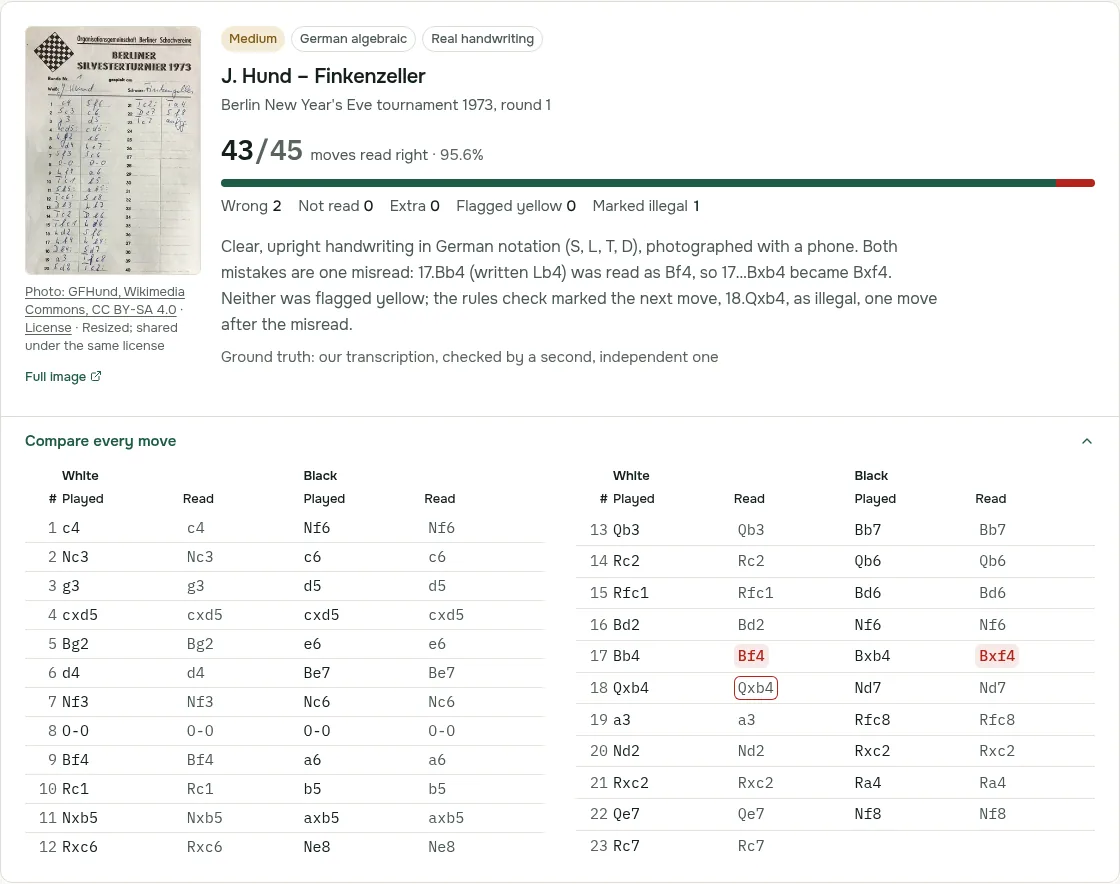
- Instead of manually retyping moves into a chess database, upload the scoresheet photo to ScanChess to transcribe handwritten notation into a verified PGN.
- For arbiters and club managers preserving game records across dozens of boards, tournament scoresheet archiving covers the complete batch digitization workflow.