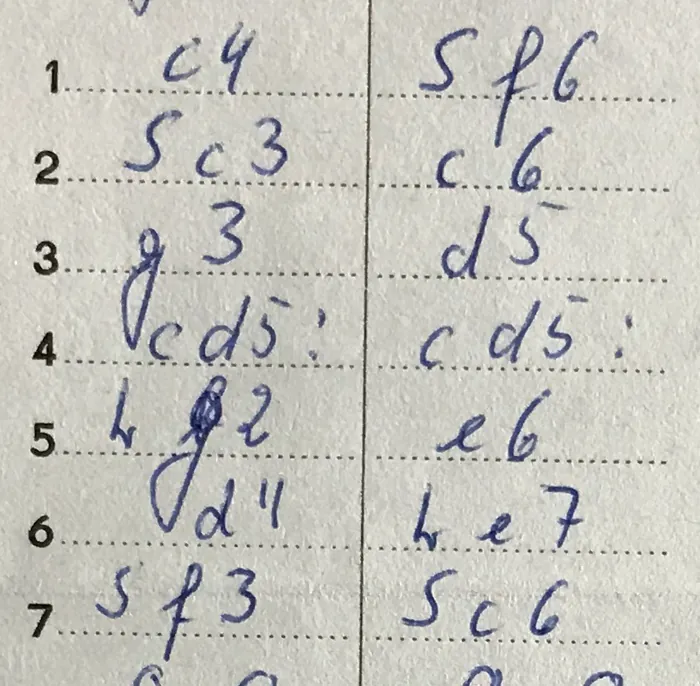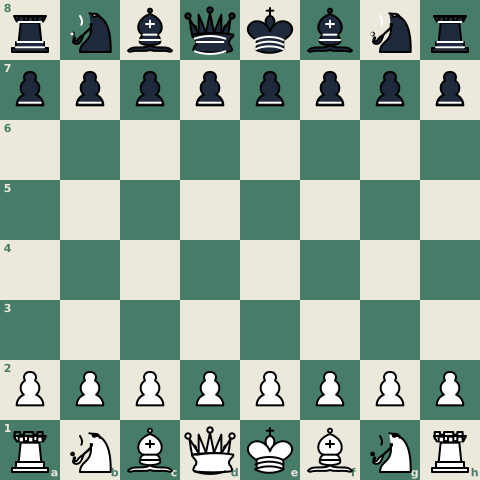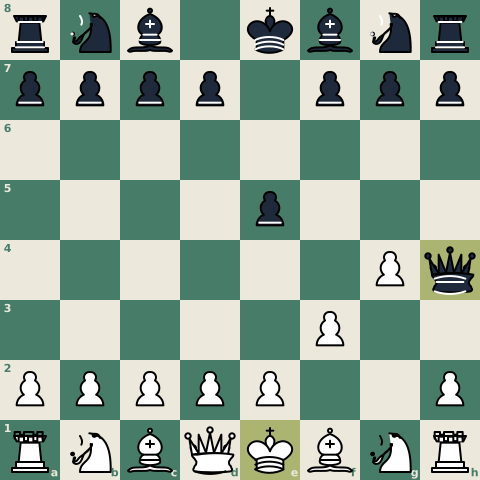

In chess books, magazine archives, and tournament bulletins printed before 1980, moves are almost universally written in descriptive notation—such as 1. P-K4 P-K4 2. N-KB3 (or 2. Kt-KB3). In modern tournament play, digital databases, and chess software, that same opening is recorded in algebraic notation (Standard Algebraic Notation, or SAN) as 1. e4 e5 2. Nf3.
The primary difference lies in perspective: descriptive notation names squares relative to each player's side of the board, meaning White and Black use different names for the exact same physical square. Algebraic notation uses a single, fixed 64-square coordinate grid (a1 through h8) that never changes. Translating an old score into modern PGN requires understanding this perspective shift, recognizing historical piece abbreviations, and resolving contextual disambiguations.
How Descriptive Notation Works
Descriptive chess notation identifies squares and moves through three core conventions:
1. Files are named after starting pieces
Instead of the letters a through h, each vertical file takes the name of the piece that occupies it in the standard starting array. The board is divided down the middle into a kingside (K) and a queenside (Q):
| File (Algebraic) | Descriptive Name | Abbreviation | Starting Piece (White / Black) |
|---|---|---|---|
| a | Queen Rook | QR | a1 Rook / a8 Rook |
| b | Queen Knight | QN | b1 Knight / b8 Knight |
| c | Queen Bishop | QB | c1 Bishop / c8 Bishop |
| d | Queen | Q | d1 Queen / d8 Queen |
| e | King | K | e1 King / e8 King |
| f | King Bishop | KB | f1 Bishop / f8 Bishop |
| g | King Knight | KN | g1 Knight / g8 Knight |
| h | King Rook | KR | h1 Rook / h8 Rook |
2. Ranks count from each player's side (The Rule of 9)
Each player numbers the ranks 1 through 8 starting from their own home rank. Because the numbers count in opposite directions:
- White's K1 is
e1, while Black's K1 ise8. - White's K4 is
e4, while Black's K4 ise5. - A move recorded as
1. P-K4 P-K4means White moves a pawn four ranks forward toe4, and Black responds by moving a pawn four ranks forward from Black's edge toe5.
A reliable mental check when transcribing old scores is the Rule of 9: for any physical square, White Rank + Black Rank = 9. If White describes a square on rank 4, Black sees that same square on rank 5 (4 + 5 = 9). If Black plays to their 3rd rank, that square sits on White's 6th rank (3 + 6 = 9).
3. Piece abbreviations and move syntax
Moves are written as Piece-DestinationSquare. Pawns are explicitly designated with a P (for example, P-Q4), whereas algebraic notation omits the pawn letter entirely (d4).
Captures are written with an x (or occasionally a colon in older European printings), pairing the capturing piece with the captured piece or square (such as PxP or BxN). Disambiguation relies on specifying the file or wing of the piece involved.
64-Square Dual-Perspective Coordinate Matrix
When reading classic game collections, mentally flipping ranks for Black is the most frequent source of transcription errors. Use this 64-square reference matrix to convert any algebraic coordinate to its White and Black descriptive names:
| Rank (SAN) | a (QR) | b (QN) | c (QB) | d (Q) | e (K) | f (KB) | g (KN) | h (KR) |
|---|---|---|---|---|---|---|---|---|
| 8 (Black 1st) | QR8 / QR1 | QN8 / QN1 | QB8 / QB1 | Q8 / Q1 | K8 / K1 | KB8 / KB1 | KN8 / KN1 | KR8 / KR1 |
| 7 (Black 2nd) | QR7 / QR2 | QN7 / QN2 | QB7 / QB2 | Q7 / Q2 | K7 / K2 | KB7 / KB2 | KN7 / KN2 | KR7 / KR2 |
| 6 (Black 3rd) | QR6 / QR3 | QN6 / QN3 | QB6 / QB3 | Q6 / Q3 | K6 / K3 | KB6 / KB3 | KN6 / KN3 | KR6 / KR3 |
| 5 (Black 4th) | QR5 / QR4 | QN5 / QN4 | QB5 / QB4 | Q5 / Q4 | K5 / K4 | KB5 / KB4 | KN5 / KN4 | KR5 / KR4 |
| 4 (White 4th) | QR4 / QR5 | QN4 / QN5 | QB4 / QB5 | Q4 / Q5 | K4 / K5 | KB4 / KB5 | KN4 / KN5 | KR4 / KR5 |
| 3 (White 3rd) | QR3 / QR6 | QN3 / QN6 | QB3 / QB6 | Q3 / Q6 | K3 / K6 | KB3 / KB6 | KN3 / KN6 | KR3 / KR6 |
| 2 (White 2nd) | QR2 / QR7 | QN2 / QN7 | QB2 / QB7 | Q2 / Q7 | K2 / K7 | KB2 / KB7 | KN2 / KN7 | KR2 / KR7 |
| 1 (White 1st) | QR1 / QR8 | QN1 / QN8 | QB1 / QB8 | Q1 / Q8 | K1 / K8 | KB1 / KB8 | KN1 / KN8 | KR1 / KR8 |
Cell format: White Name / Black Name. Example: square e4 is White's K4 and Black's K5.
Disambiguation and Quirks in Classic Literature
In algebraic notation, every move is mathematically precise on its own. In descriptive notation, moves often depend on the board position to be interpreted correctly. When reading 19th- and 20th-century literature, watch for these common conventions:
Knight notation: Kt vs. N
In 19th-century and early 20th-century books (including works by Howard Staunton, Emanuel Lasker, and José Raúl Capablanca), the Knight was abbreviated Kt to prevent any visual confusion with the King (K). In the mid-20th century, American chess publications standardized on N to save column width in print, while British publications frequently retained Kt into the 1970s. Both refer to the exact same piece: 1. P-K4 P-K4 2. Kt-KB3 is identical to 2. N-KB3 (Nf3).
Rook and Knight disambiguation
In modern SAN, when two identical pieces can move to the same destination, the move specifies the departure file or rank (such as Rad1 or R1e2). In descriptive notation, pieces are disambiguated by their originating board side:
- King's Rook vs. Queen's Rook: If White's rooks are on
a1andh1, moving the h1 rook toe1is writtenKR-K1. Moving the a1 rook toe1is writtenQR-K1. - Knights: A knight developing from
b1tod2is writtenQN-Q2(orQKt-Q2), distinguishing it from a knight ong1(KN-Q2). - Doubled pieces: If two rooks stand on the same file (for example, on
e1ande4), a move toe2is written with a rank qualifier:R(K1)-K2,R(1)-K2, or simplyR-K2if the other rook cannot legally move.
Pawn captures: PxP, BPxP, and PxQP
Modern algebraic notation always names the departure file and arrival square for pawn captures (exd4, cxd4). Descriptive notation frequently relies on contextual compression:
- If only one pawn capture is available on the entire board, the text simply records
PxP("pawn takes pawn"). - If two different pawns could capture, the text specifies the capturing pawn:
BPxP(Bishop's pawn takes pawn) orKPxP(King's pawn takes pawn). - Alternatively, the text may specify the pawn being captured:
PxQP(pawn captures Queen's pawn). - En passant is designated by adding
e.p.after the capture:PxP e.p.
Castling and check notations
- Castling: Often spelled out as
CastlesorCastles (K)for kingside (O-O), andCastles (Q)orCastles Q-sidefor queenside (O-O-O). - Checks and mate: Check is indicated by
ch,chk, or+. Double check is writtendbl ch. Checkmate appears asmateorcheckmate. - Pawn promotion: Written with the piece in parentheses or with an equals sign:
P-K8(Q)orP-K8=Q.
Side-by-Side Comparison: The Giuoco Piano
Here is how the opening moves of a Giuoco Piano compare across both systems:
   Descriptive (Classic)         Algebraic (Modern SAN)
1. P-K4       P-K4            1. e4        e5
2. Kt-KB3     Kt-QB3          2. Nf3       Nc6
3. B-B4       B-B4            3. Bc4       Bc5
4. P-B3       Kt-B3           4. c3        Nf6
5. P-Q4       PxP             5. d4        exd4
Examining these moves highlights how descriptive notation relies on board context:
| Move | Descriptive | Modern SAN | Move Meaning and Mechanics |
|---|---|---|---|
| 1 | P-K4 / P-K4 | e4 / e5 | White moves pawn to King 4 (e4); Black moves pawn to King 4 (e5). |
| 2 | Kt-KB3 / Kt-QB3 | Nf3 / Nc6 | White develops King's Knight to KB3 (f3); Black develops Queen's Knight to QB3 (c6). |
| 3 | B-B4 / B-B4 | Bc4 / Bc5 | White plays Bishop to KB4 (c4 is White's King Bishop 4); Black plays Bishop to KB4 (c5 is Black's King Bishop 4). |
| 4 | P-B3 / Kt-B3 | c3 / Nf6 | White pushes Queen Bishop's pawn to QB3 (c3); Black develops King's Knight to KB3 (f6). |
| 5 | P-Q4 / PxP | d4 / exd4 | White strikes at Queen 4 (d4); Black's e-pawn captures on d4 (exd4), recorded as PxP. |
Notice move 3: both White and Black write B-B4. To determine the algebraic square, you must look from the mover's side. White's King Bishop moving four ranks forward lands on c4. Black's King Bishop moving four ranks forward lands on c5. For a complete guide to modern algebraic notation, see our breakdown of chess notation explained.
Why Algebraic Notation Replaced Descriptive
Algebraic notation replaced descriptive notation because it is concise, unambiguous, and universal:
- No perspective flipping:
e4ise4regardless of whose turn it is, eliminating calculation errors. - Language independence: In figurine algebraic notation, piece letters are replaced by universal piece icons (such as ♘ for Knight), allowing international publications to be read across language barriers.
- Compactness: Scoresheets and tournament records take up significantly less physical space.
- Software and database compatibility: Digital game archives rely on Portable Game Notation (PGN), an open standard built exclusively on Standard Algebraic Notation. For details on how digital game records are structured, see what is PGN.
FIDE phased out descriptive notation in international events in the late 1970s and made algebraic notation mandatory in official competitions by 1981.