
The sheet in the bottom of the bag
Your child played four games on Saturday. They told you about one of them, at length, in the car. The other three are on folded paper in a backpack, and in about three weeks that paper will be somewhere nobody can find.
This is worth solving for two reasons, and neither is about becoming a chess parent who analyzes openings.
Why it is worth keeping
They will want it later. Chess is one of the few childhood activities that produces a complete, exact record of what the child was thinking at nine years old. Soccer gives you a photo; chess gives you the actual game. Players who still have their junior games treasure them in a way that surprises them.
It shows progress that a rating cannot. A rating goes up and down and tells you nothing about why. Their games from a year ago, next to this weekend's, show it plainly — the blunders that stopped happening, the endgames they now hold. That is a much better answer to "am I getting better?" than a number.
It gives you something real to say. "How did it go?" gets you a shrug. Sitting down with the actual game and asking "what were you thinking here?" gets you a conversation, and you do not need to know the answer yourself.
How to do it in two minutes
- Photograph the sheet flat on a table, straight down, with all four corners in the frame — Photo to PGN has the short checklist.
- Upload it at ScanChess. If the sheet has moves on both sides, upload both photos together; it still counts as one scan.
- Wait a few seconds while the moves are read.
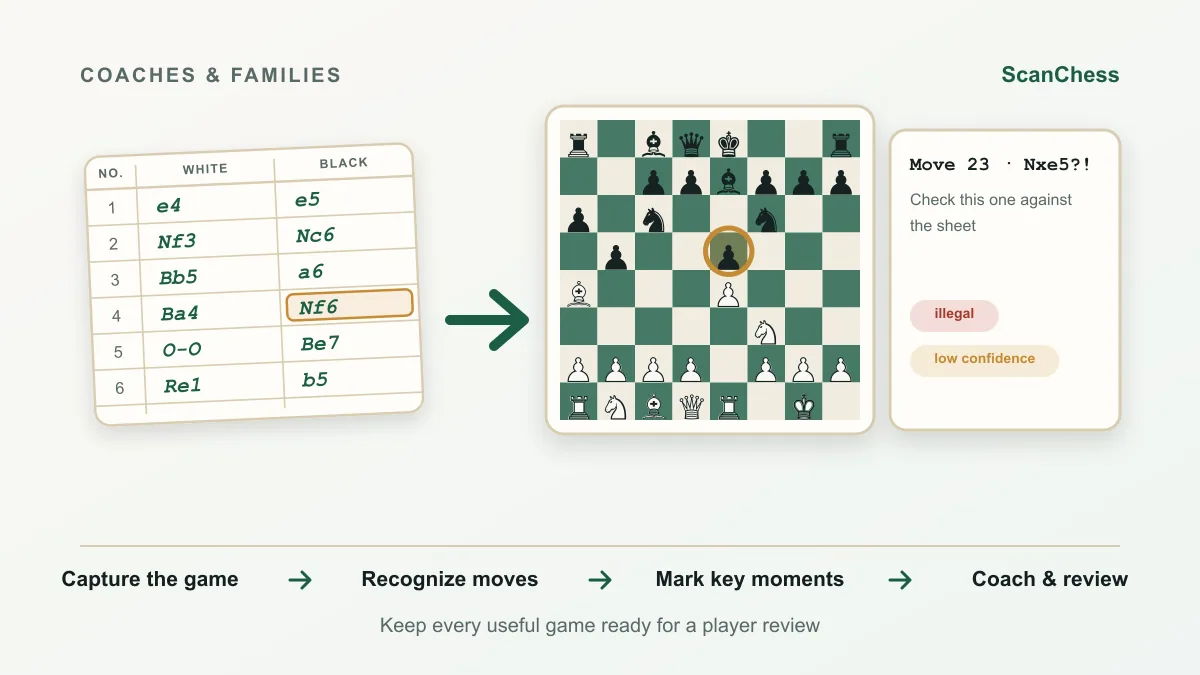
- Look at the colored moves — usually a couple per game. Red is a move that could not have happened, amber one the computer was unsure of, with the possible moves listed for you to pick from. Use the pencil button beside a move to fix it. If you cannot read the handwriting either, ask your child; they will remember.
- Download the game, or just replay it right there on the board.
That is the whole process. The hardest part is remembering to do it before the paper disappears.
The habit that makes it work
Do it on the way home, or that evening — not "sometime this week". The sheets get lost, and a lost scoresheet is a game gone for good.
A useful trick: photograph the sheets at the venue before you leave, while your child is packing up. Even if you scan them later, you have the picture.
A word about the handwriting
Junior scoresheets are, frankly, the worst case for any recognition system: pencil, small boxes, an eight-year-old writing quickly under time pressure. It still works because every move is replayed on a board as it is read, so a misreading either breaks the rules and turns red or is flagged amber, and fixing it with the pencil button costs nothing — Scan chess notation explains why.
Recognizing a sheet costs credits; everything after that — editing, replaying, saving, downloading — is free, so there is no penalty for being thorough. How credits work has the numbers.
Where it ends up
Games are saved to your account and can be opened from any device. You can download them as a PGN file, which is the universal chess format — it will open in any chess program, now and in twenty years. If your child has a Lichess or Chess.com account, the same file imports there, and they can run the engine over it themselves.
Start with the game they told you about in the car. That is the one they care about.