
The Monday morning problem
Your students played nine games over the weekend. The scoresheets are in a folder, in handwriting that ranges from neat to archaeological, and the lesson you want to teach on Wednesday depends on what actually happened in them.
The traditional options are both bad. Type them all in — twenty minutes a game, an hour before you find the position you were looking for. Or work from memory and the student's account of the game, which is exactly the unreliable narrator you are trying to correct.
What changes when the games are digital
A photo per scoresheet, a minute or two each including the check, and the weekend becomes a set of PGN files you can open in any engine. That shifts what a lesson can be:
Show them the position, not the story. "You said you were fine until you blundered — here is the move where the position was already lost, six moves earlier."
Find the pattern across games, not within one. With a student's games in one library, the recurring problem becomes visible: always short of time by move 25, always trading into a worse endgame, always the same opening left unstudied. One game hides that. Twenty games make it obvious.
Let the engine do the arithmetic. Import the PGN into Lichess or Chess.com and the accuracy graph gives you the moments worth teaching, so your preparation time goes into explaining them rather than finding them.
Give the student something to keep. A player who can see their own games from two years ago, and how much better they are now, has a reason to keep records at all.
How coaches actually use it
After the club night. Photograph the sheets before the students leave with them. It takes less time than packing up the sets.
During a tournament. Scan between rounds and you can prepare for the next opponent using their game from an hour ago, if you have that sheet.
For the archive. Older students often arrive with a box of paper from years of play. Work through it in batches — a session per event — rather than trying to clear it in one weekend. Credits never expire, so there is no rush; how credits work has the detail.
What to expect from the recognition
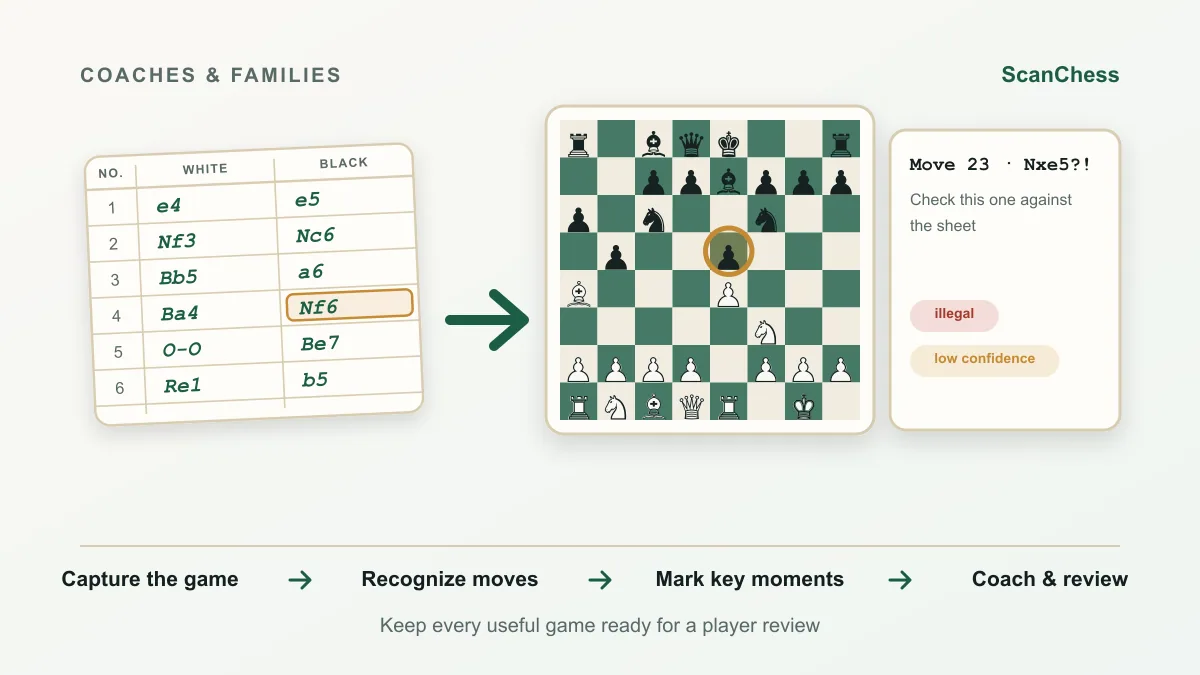
It reads handwriting, and handwriting varies. Every move is replayed on a board as it is read, so an illegal reading is marked red and an uncertain one amber with the legal alternatives to pick from; you review those few moves, fix them with the pencil button for free, and only the recognition itself uses credits — Scan chess notation explains the mechanism.
Coaches are usually photographing someone else's handwriting, which raises the stakes on the photo: flat on the table, camera parallel to the paper, daylight without your own shadow, all four corners in frame — the full checklist is on Photo to PGN.
Where to start
Take the top scoresheet off the pile and scan it. The 10 credits a new account starts with cover five of them, which is enough to find out how it handles your students' handwriting before you pay for anything.