
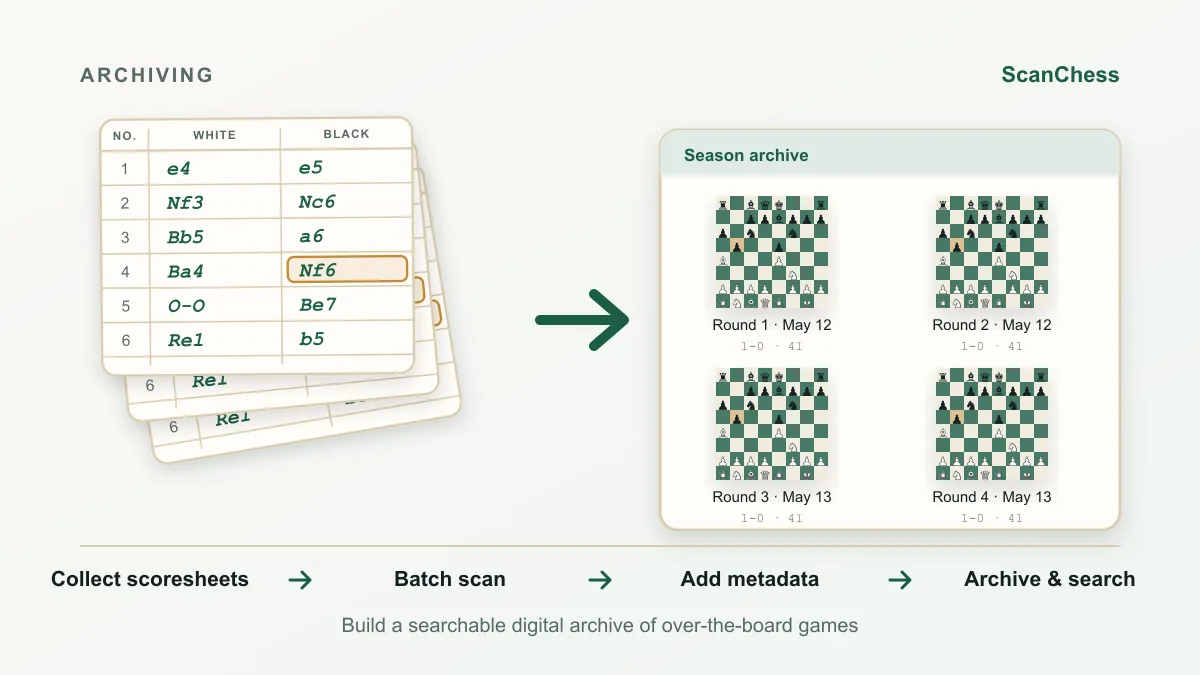
The pile at the end of the weekend
Every organizer knows the state of things on Sunday evening: two hundred sheets of paper, the results already published, and the games — the thing players actually want — locked in handwriting that nobody has time to transcribe.
So the games are usually not published at all, or only the top boards are, typed up by a volunteer over the following two weeks. The rest go in a box.
What the rules actually require
Under the FIDE Laws of Chess, each player records their own moves, both players sign the scoresheet at the end, and the signed sheet belongs to the organizer. That paper is the record: if a result is disputed, the signed scoresheet is what the arbiter rules on. FIDE scoresheet rules goes through the relevant articles.
Digitizing does not change any of that. Keep the paper for as long as your federation or your own regulations say; what the digital archive adds is publishing, searching, and reading a game two years later without going through the box.
A workflow that fits a real event
Scan between rounds, not after the event. The pile only feels impossible because it arrives all at once. Twenty sheets after each round is half an hour or so, less with two people; two hundred on Sunday night is a chore nobody volunteers for.
Photograph both sides in one go. A double-sided sheet goes up as two images in a single scan — the moves are merged in order and it counts as one scan, not two. A scan takes up to 10 images of 15 MB each (JPG, PNG or WebP; HEIC is not accepted), which covers any sheet you will meet.
Fill in the tags while the event is in front of you. Event name, site, date, round, both players, result. It takes seconds during the tournament and is genuinely hard to reconstruct later. These become the PGN's seven-tag roster, which is what makes the archive searchable.
Check the colored moves, not every move. Each move is replayed on a board as it is read, so an illegal reading is marked red and an uncertain one amber with the legal alternatives to pick from — those are what you review, as Scan chess notation explains.
Export one PGN per round. A single file with many games is valid PGN — games are separated by a blank line — and it is the easiest thing to hand to a website or a database.
What to do with the archive
Publish it. A PGN file per round, linked from the results page, is the single most appreciated thing an organizer can produce. Players will replay their own games; some will find their opponent's other games.
Load it into a Lichess Study. Import a multi-game PGN and each game becomes a chapter — a shareable, replayable event archive with no hosting on your part. See our guide to importing PGN into Lichess.
Keep it for the club's history. Twenty years of a club championship fits in a text file, which is more than a cupboard of paper can promise; Digitize your chess games covers naming and backup.
Practical notes
- A white sheet on a dark table gives the cleanest edges; the rest of the photo checklist is on Photo to PGN.
- Do the sheets in board order and keep them in order afterwards — matching a mis-scanned game back to its paper is much easier when the pile is sorted.
- Junior events produce the hardest handwriting and the most grateful parents. Budget more checking time and scan them anyway.
- Credits never expire, so buying capacity before a big event and using it over the following weeks works fine.
Start with one round
Take round one, scan it, and see how long it really takes before committing your weekend to a plan. A new account's 10 free credits cover five boards of that round — enough to time yourself honestly.