
Search "how many moves in a chess game" and you get a different average on every page, usually with no source at all. So we counted. We took 347,741 over-the-board tournament games relayed from electronic boards over the past year, and every rated game played on Lichess in August 2026, 91.9 million of them. For each game we counted the moves, read the result and, where the clocks were recorded, measured how much time the players used. The tables are free to download at the end, and the methodology section explains every rule we applied.
A "move" on this page means one move by each player, the unit a scoresheet row holds. A game that ends with White's 41st move counts as 41 moves.
Key figures
- A classical over-the-board game lasts a median of 41 moves and a mean of 43.
- Half of classical games go past move 40, 14.5% past move 60, 3.0% past move 80 and 0.7% past move 100.
- A game at 90 minutes plus 30 seconds a move uses a median of 3 hours 3 minutes on the two clocks combined. At 15+10 it is 38 minutes; at 3+2, 8 minutes.
- Online games are shorter: a median of 32 moves in Lichess bullet and blitz and 30 in rapid.
- Over the board, game length hardly depends on strength: the median is 40–42 moves in every rating band from 1400 to 2600+.
- What strength changes is the ending. Draws rise from 20.4% of classical games at 1400–1599 to 60.6% at 2600+, and checkmates fall from 28.3% to 0.8%.
- Draws cluster at move 30: 1,992 classical draws ended on move 30 against 1,140 on move 29, the pattern a rule against agreeing draws before move 30 would produce.
- White wins 39.5% of classical over-the-board games, Black 32.1%, and 28.4% are drawn.
- Online, 51.5% of bullet games and 23.0% of blitz games are won on time.
- Lichess players were checkmated by Fool's Mate, the shortest possible game, 733 times in August 2026.
How many moves does a chess game last?
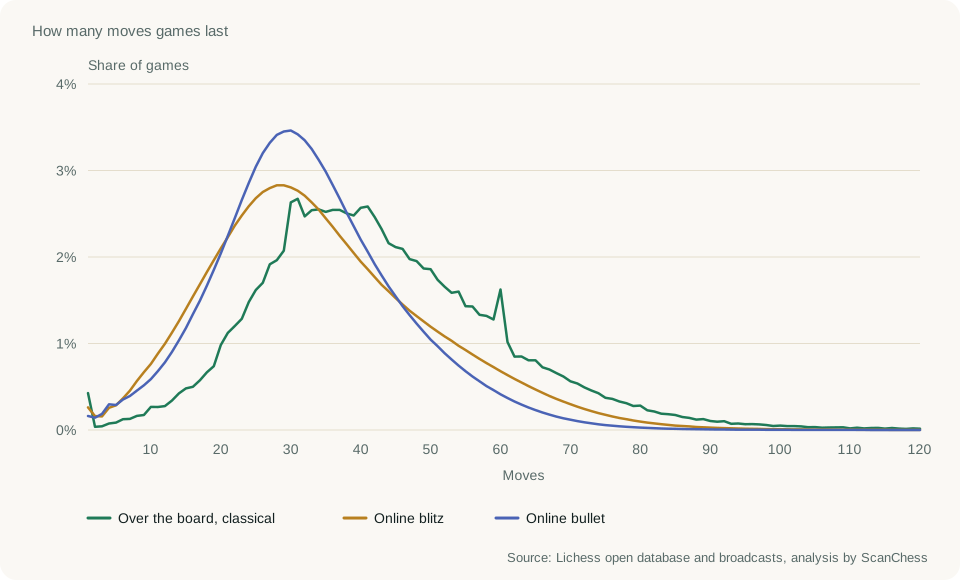
The typical length depends less on the time control than on where the game is played. Over the board, classical, rapid and blitz games all have a median of 40 or 41 moves. Online, every speed is shorter, and the spread is wider at the short end: a quarter of online rapid games are over by move 20, against 7% of over-the-board games.
| Games | Games counted | Median moves | Mean moves | Over in 20 moves | Past move 40 | Past move 60 | Past move 80 |
|---|---|---|---|---|---|---|---|
| Over the board, classical | 226,600 | 41 | 43.0 | 6.8% | 50.8% | 14.5% | 3.0% |
| Over the board, rapid | 67,395 | 41 | 43.7 | 6.6% | 51.8% | 16.2% | 3.4% |
| Over the board, blitz | 46,419 | 40 | 43.1 | 6.2% | 49.4% | 15.3% | 3.4% |
| Online, bullet | 32,266,169 | 32 | 32.7 | 16.4% | 24.8% | 3.0% | 0.2% |
| Online, blitz | 41,885,442 | 32 | 34.5 | 18.7% | 31.1% | 7.0% | 0.8% |
| Online, rapid | 15,629,349 | 30 | 32.6 | 25.7% | 27.8% | 7.4% | 1.1% |
| Online, classical | 558,126 | 30 | 32.2 | 27.1% | 27.8% | 7.6% | 1.2% |
Online classical is a small pool on Lichess, and online UltraBullet (906,038 games, median 27 moves) and correspondence (72,652 games) are in the download but not in this table.
Two things in the data go with the shorter online games. Online games are far more often decided by the clock, as the section on endings shows. And the online pool has many more low-rated players, whose games are shorter, while relayed tournament games lean toward stronger players (see the methodology).
How long does a chess game take?
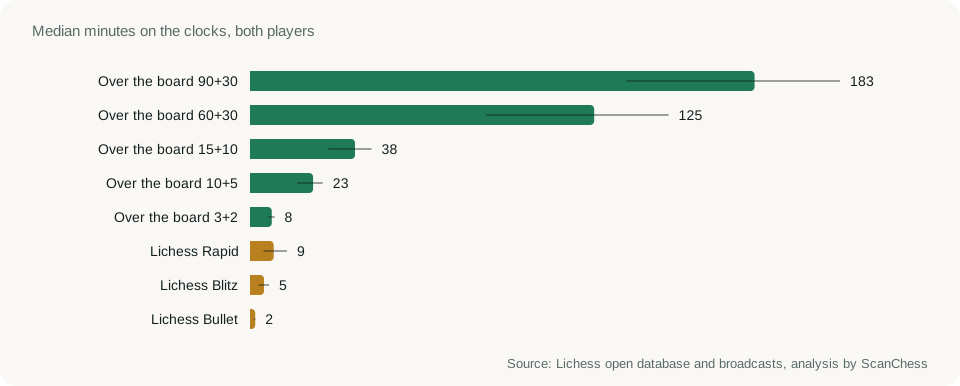
Clock time is the time the two players actually used, read from the clocks at the end of the game: the starting time plus the increments earned, minus what was left. It excludes pauses, so the time in the playing hall is a little longer.
| Time control | Games with usable clocks | 25% of games end within | Median | 75% of games end within | 90% of games end within |
|---|---|---|---|---|---|
| Over the board, 90 min + 30 s | 79,781 | 2 h 17 min | 3 h 3 min | 3 h 34 min | 3 h 52 min |
| Over the board, 60 min + 30 s | 8,720 | 1 h 26 min | 2 h 5 min | 2 h 32 min | 2 h 49 min |
| Over the board, 45 min + 10 s | 3,200 | 57 min | 1 h 21 min | 1 h 37 min | 1 h 46 min |
| Over the board, 15 min + 10 s | 20,468 | 28 min | 38 min | 44 min | 49 min |
| Over the board, 10 min + 5 s | 10,401 | 17 min | 23 min | 26 min | 29 min |
| Over the board, 3 min + 2 s | 26,773 | 7 min | 8 min | 9 min | 10 min |
| Online, rapid (Lichess) | 15,588,707 | 5 min | 9 min | 13 min | 18 min |
| Online, blitz (Lichess) | 41,813,116 | 3 min | 5 min | 7 min | 9 min |
| Online, bullet (Lichess) | 32,234,447 | 1.4 min | 1.9 min | 1.9 min | 3.9 min |
At 90+30 a player has 90 minutes plus 30 seconds for each move, so a 41-move game allows about 3 hours 41 minutes on the two clocks together. The median game uses 3 hours 3 minutes: over-the-board players spend most of the time they have. A 41-move game at 3+2 allows about 8¾ minutes, and the median game uses 8.
When do chess games end?
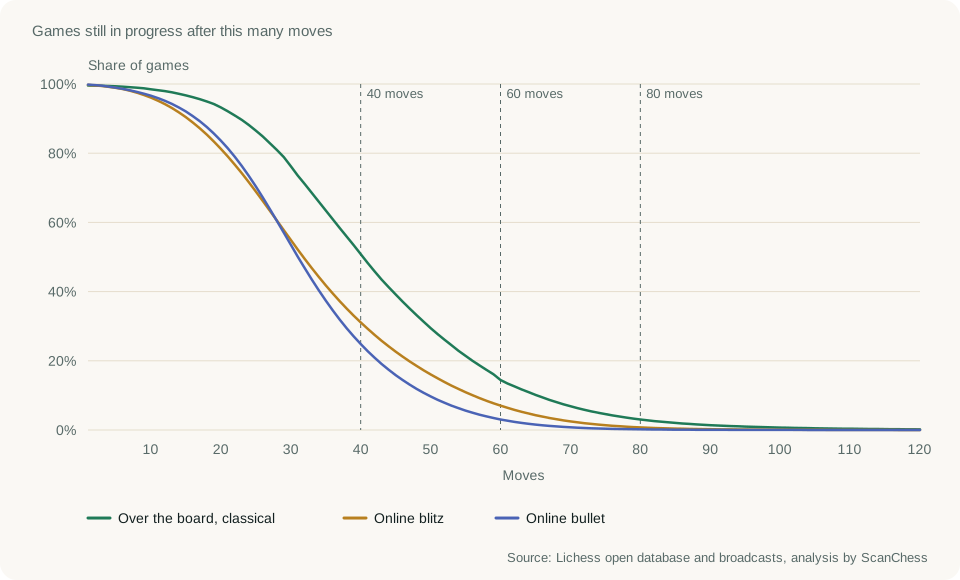
Read the curve as "how many games are still going at this move". Over the board, 93% of classical games are still going after move 20, 51% after move 40, 14.5% after move 60 and 3.0% after move 80. Online blitz games fall away far sooner: 31% are still going at move 40 and 7% at move 60.
The over-the-board curve is not smooth, because tournament rules leave marks on it:
| Classical over-the-board games ending on move | 29 | 30 | 31 | 39 | 40 | 41 | 59 | 60 | 61 |
|---|---|---|---|---|---|---|---|---|---|
| Draws | 1,140 | 1,992 | 1,972 | 1,228 | 1,282 | 1,407 | 782 | 949 | 590 |
| Decisive games | 3,556 | 3,971 | 4,085 | 4,390 | 4,538 | 4,447 | 2,113 | 2,732 | 1,715 |
- Move 30. Draws nearly double from move 29 to move 30 and stay high on move 31, while decisive games rise only gently. That is the pattern a rule against agreeing a draw before move 30, which many tournaments have, would produce.
- Move 60. Both draws and decisive games jump at move 60 and drop sharply after it. In most of the decisive games ending there, the winner made the last move, so this is not relays cutting games off. The data does not tell us why.
Draws are not always short. The median draw lasts 39 moves against 41 for a decisive game, but draws are twice as likely to run past move 80 (4.7% against 2.4%).
Do stronger players play longer games?
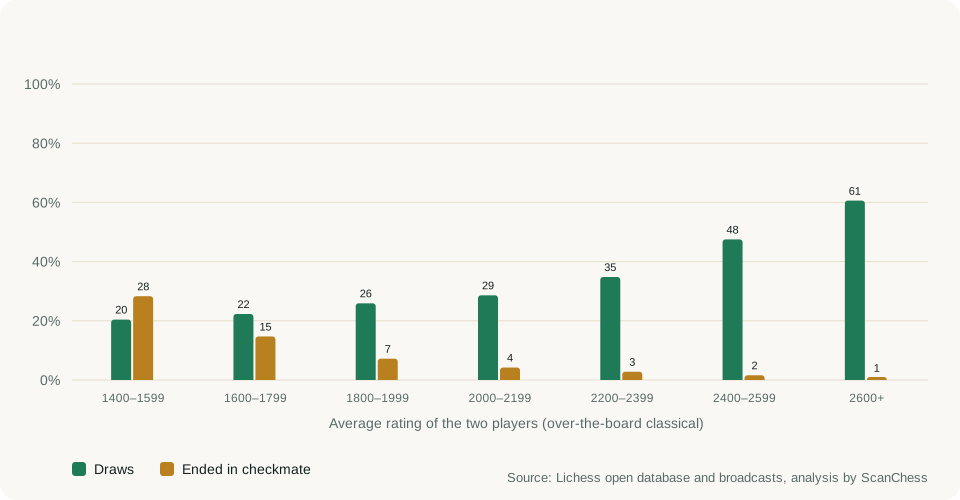
Over the board, the answer is almost no. From 1400 to 2600+, the median classical game lasts 40 to 42 moves in every band. How the games end changes completely:
| Average rating of the two players | Classical games | Median moves | Past move 60 | White wins | Black wins | Draws | Ended in checkmate |
|---|---|---|---|---|---|---|---|
| 1400–1599 | 11,168 | 41 | 14.8% | 42.3% | 37.2% | 20.4% | 28.3% |
| 1600–1799 | 32,374 | 40 | 13.4% | 42.4% | 35.3% | 22.3% | 14.7% |
| 1800–1999 | 44,672 | 41 | 13.7% | 40.5% | 33.6% | 25.9% | 7.2% |
| 2000–2199 | 46,112 | 41 | 14.9% | 39.4% | 32.0% | 28.6% | 4.2% |
| 2200–2399 | 43,787 | 42 | 15.6% | 37.0% | 28.2% | 34.8% | 2.8% |
| 2400–2599 | 20,190 | 41 | 16.0% | 31.1% | 21.4% | 47.5% | 1.6% |
| 2600+ | 2,739 | 41 | 15.7% | 25.0% | 14.3% | 60.6% | 0.8% |
At 1400–1599, more than a quarter of classical games end in checkmate. At 2600+, fewer than one in a hundred do: strong players resign lost positions rather than play on to mate. White's edge also grows with strength, from 5 points at 1400–1599 to 11 points at 2600+.
Online it is different. On Lichess the median blitz game lasts 26 moves when the players average under 1000 and 39 moves at 2400–2599, and the share of blitz games ending in checkmate falls from 34.6% to 12.8% over the same range.
How do chess games end online?
Lichess records whether a game ended normally, on time, or because a player left.
| Lichess speed | Checkmate | Won by resignation or other normal ending | Won on time | Draw |
|---|---|---|---|---|
| Bullet | 22.6% | 23.1% | 51.5% | 2.8% |
| Blitz | 24.2% | 48.4% | 23.0% | 4.2% |
| Rapid | 29.4% | 55.2% | 10.6% | 4.6% |
| Classical | 30.6% | 55.9% | 7.9% | 5.5% |
Half of all bullet games are decided by the clock, not the board. From blitz upward, a resignation or another normal finish is the most common way a game is won, as it is over the board. Draws are rare online, 3–6% of games against 28.4% of classical games over the board.
The shortest games are rare but real. In August 2026, Lichess players lost to Fool's Mate (checkmate on Black's second move) 733 times, and 60,885 games ended in checkmate on White's fourth move, the length of Scholar's Mate.
How many moves fit on a scoresheet?
Under Article 8.1 of the FIDE Laws of Chess, both players must write down every move in a standard game. Article 8.4 lifts the duty only when a player has less than five minutes left and no increment of 30 seconds or more, so at 90+30 every move of the game goes on the sheet.
The counts above translate directly into paper:
- A 60-move sheet holds the whole game 85.5% of the time. One classical game in seven needs a second sheet.
- An 80-move sheet holds 97.0% of classical games.
- A 40-move sheet, the large-row format used for juniors, holds 49.2%.
Our printable scoresheets come in all three lengths, and our guide to FIDE's scoresheet rules covers when you must keep score and when you may stop.
Methodology and definitions
- Over-the-board games. The Lichess broadcast database, September 2025 to August 2026: 388,213 games relayed from over-the-board events, mostly from electronic boards. We excluded games without a final result (23,193), chess variants (3,530), games with no moves (3,810), engine championships (2,803), online events (5,790), the same game relayed by two broadcasts (1,335), games from a set-up position (5) and games cut off by the relay at move 300 (6). 347,741 games remain.
- Online games. Every rated standard game in the Lichess open database for August 2026: 91,912,325 games, matching the count Lichess publishes, read from the full 30.1 GB file. We excluded games without a result (17,753), games in which no move was played (169,768) and games involving a Lichess BOT account (407,028): engines are under 1% of games overall but almost every rapid game rated 2600+, so leaving them in would have described machines, not people. 91,317,776 games remain.
- A move is one move by each player: moves = plies ÷ 2, rounded up. Every game was measured by counting moves, not by reading a header, and we checked the counter by replaying 78,611 games move by move with a chess library: it matched every one, including every checkmate.
- Over-the-board time class follows the FIDE Laws: a player's time is the base time plus 60 times the increment. 10 minutes or less is blitz, more than 10 and less than 60 is rapid, 60 or more is classical. The base time is read from the first clock reading, because the time control header is free text and "180+2" means three minutes at one event and three hours at another.
- Online speed follows Lichess: base time plus 40 times the increment, under 30 seconds UltraBullet, under 3 minutes bullet, under 8 minutes blitz, under 25 minutes rapid, otherwise classical. Our rule agreed with Lichess's own label on every game.
- Clock time is the starting time of both players plus the increments earned, minus the two final clock readings, for games whose time control header matched their clocks. It leaves out pauses and anything outside the clocks.
- Rating band is the average of the two players' ratings shown in the game header: FIDE ratings for most over-the-board games, Lichess ratings online.
- Limits. Relayed events are not a random sample of all tournament chess. They lean toward well-organized events with electronic boards and toward stronger players: 59% of the classical games are between players averaging 1800–2400. A relay can also record a wrong move, which counting cannot detect.
Download the data
- Game length by time control (CSV): games, percentiles, shares past each move mark, results and checkmates for every over-the-board time class and Lichess speed
- Games by number of moves (CSV): how many games ended at each move from 1 to 300, per group, including classical draws and decisive games separately
- Game length by rating (CSV): over-the-board classical, Lichess rapid and Lichess blitz by 200-point rating band
- Game duration (CSV): clock time quartiles for 40 time controls
- Every figure on this page (JSON)
The tables are published under CC BY-SA 4.0, the license of the Lichess broadcast games they are partly built from. To cite this page:
ScanChess, "How Long Is a Chess Game? Moves and Minutes From 91 Million Games", data from the Lichess open database and broadcasts, https://scanchess.com/blog/how-long-is-a-chess-game
For another data page from the same series, see FIDE rated players in 2026.
A median tournament game fills 41 rows of a scoresheet in about three hours. ScanChess turns a photo of those rows into a PGN you can replay and analyze.