
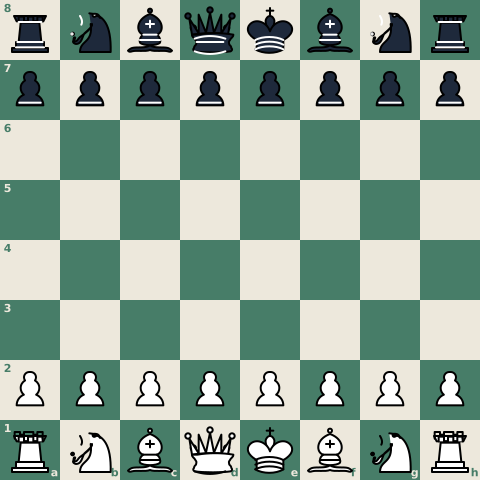
Every game of chess starts from the same position, and getting it right takes about a minute once you know the order. There are two things to get right: which way the board faces, and where each of the sixteen pieces per side goes. The diagram above is the finished setup, seen from White's side. The steps below build it from an empty board.
Step 1: Turn the Board So a Light Square Is on Your Right
Before any piece goes down, look at the corner square nearest your right hand. It must be a light square. The rule is written into the FIDE Laws of Chess (Article 2.1), and the memory aid most coaches use is "light on the right" or "white on the right".
This one check matters more than anything else. A board turned the wrong way puts the king and queen on the wrong squares, and every opening you have learned looks strange.
Step 2: Put the Rooks in the Corners
The rooks (the pieces shaped like castle towers) go on the four corner squares. White's rooks stand on a1 and h1, Black's on a8 and h8.
Step 3: Knights Next to the Rooks
Each knight (the horse) stands beside a rook, one square in from the corner: White on b1 and g1, Black on b8 and g8. Turn the knights to face forward; it changes nothing in the rules, but it is the convention and makes the board easier to read.
Step 4: Bishops Next to the Knights
The bishops (the pieces with a slit in the top) go next to the knights: White on c1 and f1, Black on c8 and f8. You now have two empty squares in the middle of each back rank.
Step 5: Queen on Her Own Color, King Beside Her
The two middle squares are where most setup mistakes happen. The rule is "queen on her color":
- The white queen goes on the light square, d1.
- The black queen goes on the dark square, d8.
The kings take the last empty square: the white king on e1, the black king on e8. If you did it correctly, the two queens face each other along the d-file and the two kings face each other along the e-file.
Step 6: Line Up the Pawns
Place White's eight pawns on the second rank, a2 to h2, and Black's eight pawns on the seventh rank, a7 to h7. That completes the position. White always moves first.
The Setup at a Glance
| Piece | White | Black |
|---|---|---|
| Rooks | a1, h1 | a8, h8 |
| Knights | b1, g1 | b8, g8 |
| Bishops | c1, f1 | c8, f8 |
| Queen | d1 (light square) | d8 (dark square) |
| King | e1 | e8 |
| Pawns | a2–h2 | a7–h7 |
The same position written as a single line of text, the way chess software stores it, is the starting-position FEN: rnbqkbnr/pppppppp/8/8/8/8/PPPPPPPP/RNBQKBNR w KQkq - 0 1. When loading a game in the ScanChess PGN viewer, this is the string shown as "Current position" before any move. Our guide to FEN notation explains how to read that line, and you can load it on the chess board editor with the Start position button.
Three Setup Mistakes to Check For
The board is rotated a quarter turn. Both players have a dark square on their right, and the letters and numbers on the board edge run along the wrong sides. Turn the board 90 degrees before placing anything.
King and queen are swapped. The white king ends up on d1 and the queen on e1. Check that each queen stands on a square of her own color.
Knights and bishops are swapped. It happens when pieces are set up quickly from the middle outward. From the corner in, the order is always rook, knight, bishop.
What Happens If a Tournament Game Starts from the Wrong Setup
The FIDE Laws cover this in Article 7. If a game is found to have started with the pieces in the wrong places, it is canceled and a new game is played. If only the board was turned the wrong way, the game continues, and the position reached is transferred to a correctly placed board. If the players started with their colors reversed, the game is stopped and restarted with the correct colors if fewer than ten moves have been made by both players; after ten moves or more, it continues as it is. The clock's position is the arbiter's decision too (Article 6.5). At an event, call the arbiter rather than fixing a setup problem yourselves.
After the Setup: Writing the Game Down
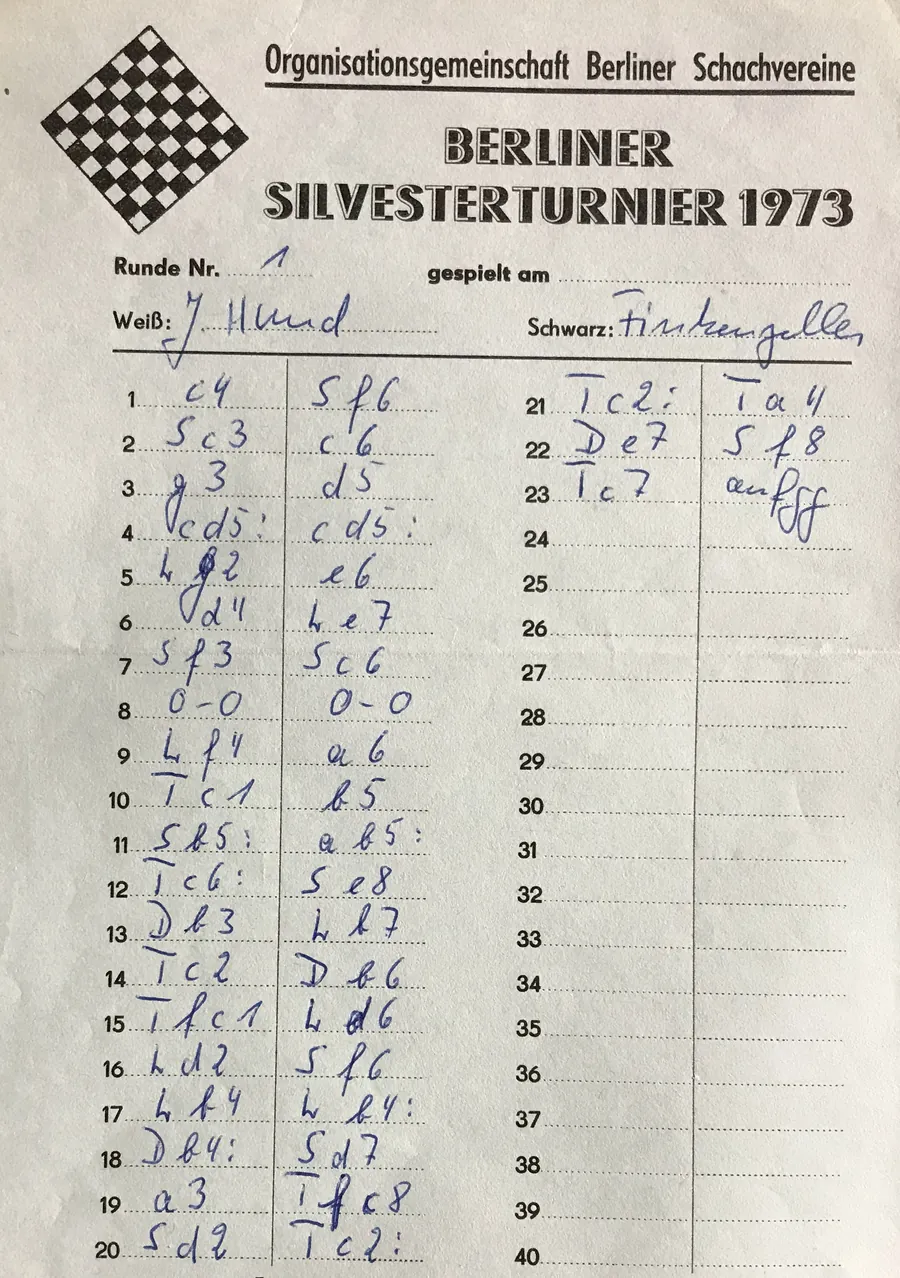
At a tournament you will also have a score sheet next to the board. The squares you used above (a1, e8, d1) are the same coordinates you will write every move with, so it is worth learning them now. Chess notation explained covers how to write moves, and how to fill out a chess scoresheet covers the sheet itself. If you need blank sheets, the printable score sheets are free; when the game is over, ScanChess can read the finished sheet and turn it into a game you can replay.